
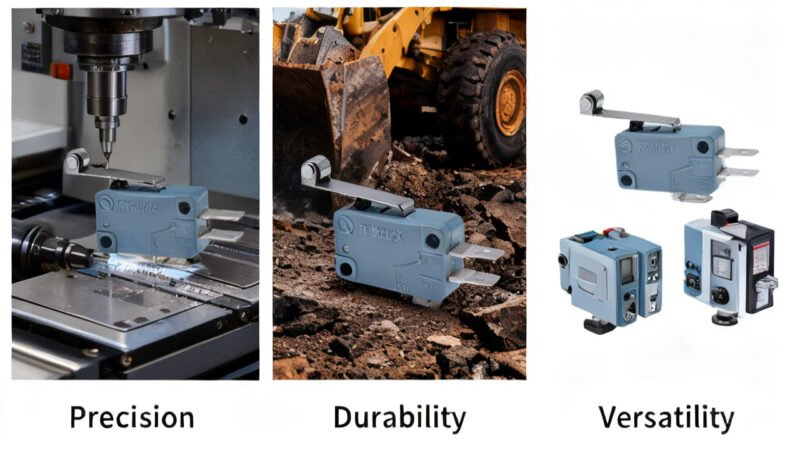
In the intricate landscape of modern industrial automation and consumer electronics, countless unseen components work tirelessly to ensure precision, safety, and efficiency. Among these critical elements, the micro switch stands out as a fundamental building block. Often overlooked, these diminutive devices are the silent workhorses enabling a vast array of functionalities, from simple on/off controls to complex safety interlocks. For engineers, product developers, and procurement professionals, understanding the nuances of micro switches – their types, applications, and selection criteria – is paramount to achieving robust and reliable designs.
At its core, a micro switch is a snap-action electrical switch known for its rapid and decisive change of state. It features a highly sensitive trigger mechanism that, when actuated by a small physical force, quickly opens or closes an electrical circuit. This ‘snap-action’ characteristic is crucial, as it ensures a fast make-or-break operation regardless of the speed of actuation, minimizing arcing and extending the switch’s operational life. Typically housed in a compact casing, these switches employ a spring-loaded lever or plunger that, upon reaching a specific displacement point, triggers the internal contact mechanism with a distinct audible click.
Key Characteristics and Advantages
The widespread adoption of micro switches across various sectors is due to several inherent advantages:
- Precision and Repeatability: Micro switches offer extremely precise operating points and consistent performance over millions of cycles. This high repeatability makes them ideal for applications requiring exact positioning or timing.
- Durability and Longevity: Designed for demanding environments, these switches are engineered for long mechanical and electrical lifespans, often exceeding 10 million operations.
- Compact Design: Their small footprint allows for integration into space-constrained applications, a significant advantage in miniaturized devices and complex machinery.
- Versatility in Actuation: Available with a variety of actuators (pin plungers, roller levers, hinge levers, etc.), they can be tailored to specific application needs, accommodating different input forces and travel distances.
- High Current Capacity: Despite their small size, many micro switches are capable of handling significant electrical loads, making them suitable for controlling motors, solenoids, and other power-intensive components.
Diverse Applications Across Industries
The utility of the micro switch spans an incredible range of industries and products:
- Automotive: Used in door latches, seat belt detection, gear shift mechanisms, and power window controls.
- Home Appliances: Found in microwave ovens (door interlocks), washing machines (lid safety switches), refrigerators (ice dispenser mechanisms), and vacuum cleaners.
- Industrial Control: Critical for safety interlocks on machinery, position sensing in robotic arms, conveyor belt monitoring, and control panels. This is where the limit switch variant often plays a crucial role.
- Medical Devices: Integrated into hospital beds, infusion pumps, and diagnostic equipment for precise control and safety.
- HVAC Systems: Employed in thermostats, damper controls, and fan interlocks.
- Security Systems: Used in tamper switches for alarms and access control systems.
Types of Micro Switches for Specific Needs
Standard Micro Switches
These are the ubiquitous snap-action switches, available in various sizes and electrical ratings. They form the foundational category, offering reliable switching for general-purpose applications where environmental factors are not extreme.
Limit Switches: The Guardians of Position
A specialized form of micro switch, the limit switch is fundamentally designed to detect the presence or absence of an object or to monitor the travel limits of moving parts in machinery. They are robust, often enclosed in protective housings, and commonly used in industrial automation to control and sequence operations, provide safety interlocks, and prevent over-travel. Their precise and repeatable actuation point makes them indispensable in manufacturing lines, CNC machines, and robotic systems.
Waterproof Micro Switches: Conquering Harsh Environments
For applications exposed to moisture, dust, or other contaminants, a waterproof micro switch is essential. These switches are sealed to an IP (Ingress Protection) rating, indicating their resistance to solids and liquids. Common IP ratings for waterproof switches include IP67, signifying complete protection against dust and temporary immersion in water. They are critical in outdoor equipment, marine applications, food processing machinery, and automotive under-the-hood components, ensuring reliable operation even in challenging conditions.
Mini Micro Switches: Power in Compact Form Factors
As devices become smaller and more integrated, the demand for miniature components grows. Mini micro switches, such as the MQS-9A Mini Micro Switch, are designed to fit into extremely tight spaces without compromising performance. Despite their reduced size, they maintain the snap-action precision and durability of their larger counterparts. These are frequently found in consumer electronics, portable devices, and intricate medical instruments where space is at a premium.
Choosing the Right micro switch manufacturer and Product
Selecting the appropriate micro switch requires careful consideration of several factors:
- Electrical Ratings: Ensure the switch can safely handle the required voltage and current for both AC and DC applications.
- Actuator Type: Match the actuator (e.g., pin plunger, roller lever, simulated roller lever, hinge lever) to the mechanical input mechanism of your application.
- Operating Force: Determine the force required to actuate the switch, which can impact user experience or mechanical design.
- Environmental Conditions: For harsh environments, specify IP-rated waterproof micro switches. Consider temperature ranges, vibration, and shock resistance.
- Mounting Options: Evaluate the available mounting styles (e.g., panel mount, PCB mount, screw mount) for ease of integration.
- Certifications: Verify that the switch meets relevant safety and quality standards (e.g., UL, CQC, ENEC).
- Manufacturer Reputation: Partnering with a reputable micro switch manufacturer is crucial. Companies like TONELUCK micro switch are known for their quality, consistency, and technical support, offering a wide range of reliable products including custom solutions. A trusted manufacturer ensures product longevity, compliance, and readily available technical data.
Conclusion
The humble micro switch, in its many forms – from standard models to robust limit switches, sealed waterproof micro switches, and compact mini micro switches like the MQS-9A – is an indispensable component driving the functionality and safety of countless devices and systems worldwide. For professionals in design and engineering, a thorough understanding of these versatile switches and a discerning choice of micro switch manufacturer are essential for developing products that are not only innovative but also reliable, durable, and perform optimally under diverse operational demands.
