
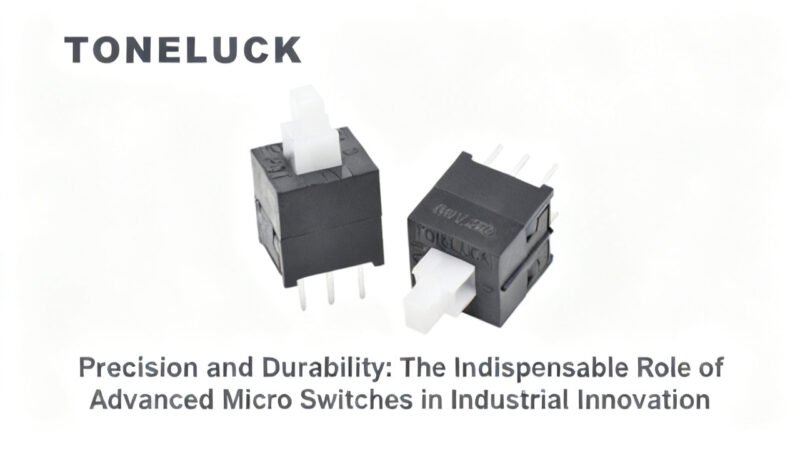
In the intricate world of industrial automation, consumer electronics, and specialized equipment, the reliability of even the smallest components can dictate the success or failure of an entire system. Among these critical components, the micro switch stands out as a fundamental element, serving as the silent workhorse that enables precise control, detection, and safety across countless applications. For engineers, product designers, and procurement specialists, understanding the nuances of these vital devices is paramount to ensuring system integrity and performance.
A micro switch, often referred to as a miniature snap-action switch, is a small, highly sensitive electromechanical device designed to open or close an electrical circuit with a rapid, decisive action. This “snap-action” mechanism provides a quick, consistent contact transfer, minimizing arcing and extending the switch’s operational life. Their compact size, high reliability, and robust performance make them indispensable in environments ranging from factory floors to medical devices, and from automotive systems to smart home appliances. The fundamental principle of a micro switch allows for precise control with minimal physical input, making them ideal for detection, interlock, and position-sensing applications.
Diverse Applications Across Industries
The versatility of micro switches is evident in their widespread adoption across a multitude of sectors. They are integral to:
- Industrial Automation: Used extensively as limit switches for position sensing, safety interlocks on machinery, and controls in conveyor systems, robotics, and assembly lines. A robust limit switch ensures precise stopping and starting, preventing over-travel and enhancing operational safety and efficiency in automated processes.
- Automotive Sector: Found in critical functions such as door latches, seat belt sensors, gear shift mechanisms, and power window controls, where their reliability is paramount for user safety and comfort, and compliance with stringent automotive standards.
- Home Appliances: Essential for safety interlocks in microwave ovens, washing machines, refrigerators, and dishwashers, ensuring components are correctly positioned and safe before operation, thereby protecting users and extending appliance life.
- Medical Equipment: Critical in devices requiring precise feedback and high reliability, such as infusion pumps, surgical tools, and patient monitoring systems, where accuracy, longevity, and consistent performance are non-negotiable for patient care.
- IoT and Smart Devices: Their compact footprint makes them ideal for integration into smart locks, security cameras, and other connected devices, enabling sophisticated control and feedback mechanisms in ever-smaller form factors.
Key Considerations When Selecting a Micro Switch
Choosing the right micro switch involves evaluating several critical parameters to ensure optimal performance, longevity, and safety in its intended application:
- Electrical Rating: This specifies the maximum voltage and current the switch can safely handle. Exceeding these limits can lead to premature failure, overheating, or safety hazards. It’s crucial to match the switch’s rating to the circuit’s requirements.
- Mechanical and Electrical Life: Measured in cycles, this indicates the expected durability. High-quality switches offer millions of mechanical and electrical cycles, crucial for applications requiring frequent actuation and long-term reliability.
- Operating Force and Travel: The force required to actuate the switch and the distance the actuator moves before snapping. These factors are critical for user interface design, precise mechanical integration, and ensuring consistent operation in automated systems.
- Operating Temperature Range: Switches must perform reliably within the environmental temperature extremes of their application. Extreme temperatures can affect contact resistance, spring tension, and plastic housing integrity.
- Environmental Protection (IP Rating): For harsh environments, such as those exposed to dust, moisture, or chemicals, waterproof micro switches with appropriate IP (Ingress Protection) ratings are essential. An IP67 rated waterproof micro switch, for instance, offers complete protection against dust ingress and temporary immersion in water, ensuring uninterrupted operation and system integrity in challenging conditions.
- Actuator Type: The choice of actuator (e.g., plunger, roller plunger, lever, simulated roller lever) depends on the mechanical interface and the method of actuation, influencing both functionality and mounting options.
- Contact Material: Gold contacts are often preferred for low-current applications requiring high reliability and resistance to oxidation, while silver alloys are common for higher current loads due to their excellent conductivity and arc resistance.
- Size and Mounting: From standard to miniature and subminiature designs, the physical dimensions and mounting options (e.g., panel mount, PCB mount) must align with product design constraints and available space. For example, the MQS-9A Mini Micro Switch exemplifies how compact yet robust designs can be integrated into space-constrained applications without compromising performance or reliability.
The Importance of a Trusted micro switch manufacturer
The quality and reliability of micro switches are directly tied to the expertise and manufacturing capabilities of their micro switch manufacturer. Partnering with a reputable manufacturer offers several distinct advantages:
- Engineering Excellence: Leading manufacturers invest heavily in research and development, producing switches that push the boundaries of performance, miniaturization, and durability, often incorporating proprietary technologies.
- Rigorous Quality Control: Adherence to international standards (e.g., UL, CE, CQC) and comprehensive testing protocols ensures consistent product quality, safety, and compliance with global regulations.
- Customization Capabilities: Many advanced applications require bespoke solutions. A skilled manufacturer can offer tailored designs, materials, and specifications to meet unique project demands, from custom actuation forces to specialized environmental seals.
- Technical Support and Expertise: Access to expert guidance during the design and integration phases can significantly streamline development cycles, prevent costly errors, and optimize component selection for specific use cases.
Companies like TONELUCK micro switch have established themselves as industry leaders by consistently delivering high-performance, reliable switching solutions. Their commitment to innovation and quality ensures that engineers and product developers have access to components that can withstand the rigors of demanding environments and complex operational profiles. Whether it’s a standard industrial application or a specialized requirement for a waterproof micro switch, TONELUCK’s comprehensive product portfolio, including compact models like the MQS-9A Mini Micro Switch, provides robust options for critical control functions, enabling greater design flexibility and product reliability.
Future Trends and Conclusion
As industries continue to evolve towards greater automation, miniaturization, and connectivity, the demand for advanced micro switches will only intensify. Innovations in materials science, sealing technologies, and manufacturing processes will lead to even more compact, durable, and environmentally resilient switches, capable of operating in increasingly challenging conditions. For designers and engineers, selecting the right micro switch is not merely a component choice; it’s a strategic decision that profoundly impacts the overall reliability, safety, and performance of their end products. By understanding the critical factors involved and partnering with an experienced micro switch manufacturer, businesses can ensure their systems are built on a foundation of precision and enduring quality, ready to meet the demands of tomorrow’s technological landscape.
