
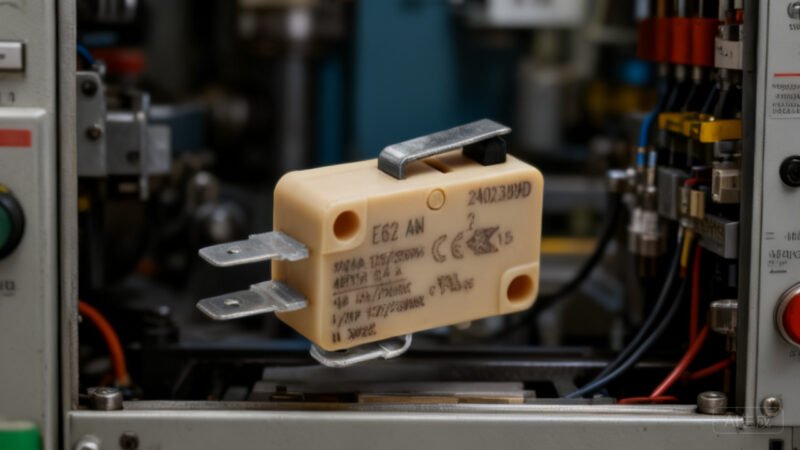
In the intricate world of industrial automation and electronic design, the smallest components often wield the greatest influence over performance, reliability, and safety. Among these unsung heroes, micro switches and limit switches stand out as fundamental building blocks, enabling precise control, accurate sensing, and robust operational integrity across a myriad of applications. For businesses operating in sectors ranging from automotive and medical devices to heavy machinery and consumer electronics, understanding the nuances of these critical components is paramount to ensuring system longevity and efficiency.
A micro switch, often referred to as a miniature snap-action switch, is a fast-acting contact mechanism designed to make or break an electrical connection with a highly predictable and repeatable action. Its core principle involves a sensitive spring mechanism that rapidly changes the state of its electrical contacts when a small amount of force is applied to its actuator. This “snap-action” ensures a quick break and make, minimizing arcing and extending the switch’s electrical life.
Key characteristics that make micro switches indispensable:
- High Precision and Repeatability: Their design ensures consistent actuation points, crucial for applications requiring exact positioning or timing.
- Durability: Engineered for millions of cycles, making them ideal for high-frequency operations.
- Compact Size: Their miniature footprint allows for integration into tight spaces, a significant advantage in modern compact designs, exemplified by products like the MQS-9A Mini Micro Switch.
- Versatility: Available with various actuator types (lever, roller, plunger) and contact configurations (SPDT, SPST-NO, SPST-NC) to suit diverse operational requirements.
Common applications for micro switches include safety interlocks in industrial machinery, door sensors in appliances, control mechanisms in medical equipment, and tactile feedback in human-machine interfaces.
Limit Switches: Defining Operational Boundaries
Building upon the principles of micro switch technology, limit switches are electromechanical devices designed to detect the presence or absence of an object, or to monitor the position of moving parts within a system. They typically feature a robust housing and a more substantial actuator designed to withstand harsher industrial environments and mechanical forces. When an object makes physical contact with the actuator, the internal micro switch mechanism triggers, sending an electrical signal to the control system.
The primary functions of limit switches are:
- Position Sensing: Determining the end-of-travel limits for machinery, such as conveyor belts, robotic arms, or automated gates.
- Presence Detection: Confirming if a component is in place or if a safety guard is closed.
- Counting: Registering the passage of items on an assembly line.
- Safety Interlocks: Preventing machinery operation if certain conditions (e.g., a protective cover being open) are not met.
While often incorporating a micro switch internally, limit switches are distinguished by their protective enclosures and often more robust external actuators, making them suitable for heavy-duty industrial applications where direct mechanical interaction is common.
Critical Considerations for B2B Procurement
Selecting the right micro or limit switch is a decision with far-reaching implications for product performance, maintenance costs, and overall system reliability. B2B buyers must meticulously evaluate several key factors:
Environmental Resilience: The Imperative of Waterproof Micro Switches
For applications exposed to moisture, dust, oils, or other contaminants, standard switches simply won’t suffice. This is where waterproof micro switches become indispensable. These specialized switches feature enhanced sealing (e.g., epoxy potting, O-rings, sealed housings) to achieve high IP (Ingress Protection) ratings, such as IP67 or IP68. This protection ensures reliable operation in challenging environments, preventing short circuits, corrosion, and mechanical failure due to ingress. Industries like automotive, outdoor equipment, marine, and food processing rely heavily on these robust components to maintain operational integrity.
Durability and Lifecycle
Evaluate the mechanical and electrical life cycles. A high-quality switch should offer millions of operations, ensuring a long service life and reducing the frequency of replacements and associated downtime.
Electrical Specifications
Match the switch’s voltage and current ratings to the application’s requirements. Consider both AC and DC loads, as well as inductive versus resistive loads, which can significantly impact contact wear.
Operating Force and Pre-travel/Overtravel
These parameters define how much force is required to actuate the switch and the physical distance the actuator can move before and after actuation. Precision applications demand switches with tight tolerances in these areas.
Actuator Type and Mounting Options
From pin plungers and roller levers to simulated rollers and flexible wires, the actuator type dictates how the switch interacts with the object it’s sensing. Mounting options (panel mount, PCB mount, screw mount) are also crucial for integration.
Material Science
The choice of housing material (e.g., thermoplastic, metal), contact material (e.g., silver alloy, gold plating), and terminal type (solder, quick connect, wire leads) directly impacts performance, corrosion resistance, and longevity.
The Mark of a Quality micro switch manufacturer
The reliability of your end product is directly tied to the quality of its components. Partnering with a reputable micro switch manufacturer is not just a preference; it’s a strategic imperative. Manufacturers like TONELUCK, for instance, are known for their commitment to precision engineering, rigorous quality control, and extensive R&D. A leading manufacturer will offer:
- Comprehensive Product Range: A wide selection of standard and specialized switches, including various micro switch types and robust limit switches.
- Customization Capabilities: The ability to tailor switches to unique application requirements.
- Adherence to International Standards: Compliance with certifications like UL, CE, RoHS, ensuring global market acceptance and safety.
- Technical Support and Expertise: Providing guidance on selection, integration, and troubleshooting.
- Consistent Quality and Supply Chain Reliability: Ensuring that components meet specifications consistently and are available when needed.
The Future Landscape: Smart Sensing and Miniaturization
The evolution of micro and limit switches continues, driven by the demands of Industry 40 and the Internet of Things (IoT). We are seeing trends towards even greater miniaturization (as seen with the MQS-9A Mini Micro Switch), enhanced sensitivity, and the integration of smart features. Future iterations may incorporate embedded intelligence for predictive maintenance or offer wireless communication capabilities, further solidifying their role as critical data points in connected industrial ecosystems.
Conclusion
Micro switches and limit switches, while often overlooked, are foundational to the precision, safety, and efficiency of countless industrial and commercial systems. From the rapid, repeatable action of a miniature micro switch to the robust position sensing of an industrial limit switch, their careful selection and integration are vital. By prioritizing quality, understanding specific application demands—especially for environments requiring waterproof micro switches—and partnering with an experienced micro switch manufacturer, businesses can unlock unparalleled reliability and performance, driving innovation and operational excellence in a competitive landscape.
