
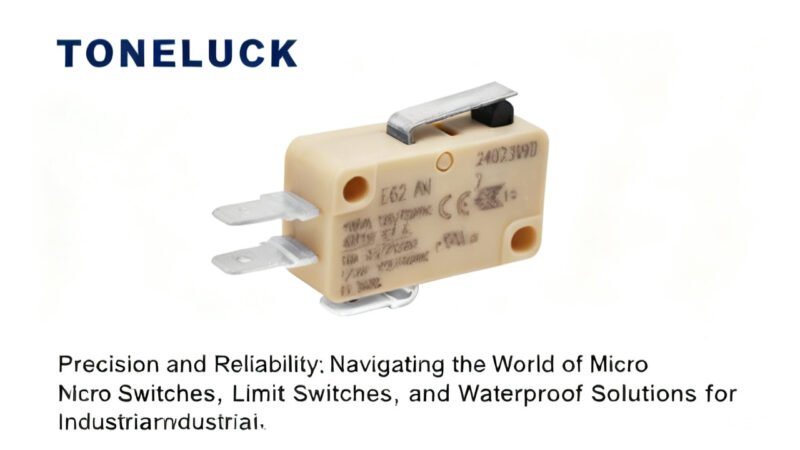
In the intricate landscape of modern industrial automation and consumer electronics, the seemingly small micro switch plays a colossal role. These compact, sensitive devices are fundamental to the operation of countless systems, acting as critical interfaces between the physical world and electronic control circuits. From ensuring safety in heavy machinery to providing tactile feedback in everyday appliances, their impact is pervasive and indispensable. Understanding their types, applications, and the importance of choosing a reliable micro switch manufacturer is paramount for engineers and procurement specialists aiming for robust and efficient designs.
What is a Micro Switch? Defining the Fundamental Concept
At its core, a micro switch, also known as a miniature snap-action switch, is an electrical switch actuated by very little physical force, typically through a tipping point mechanism. It features an internal spring mechanism that produces a rapid, decisive transfer of contacts from one position to another, irrespective of the speed of the actuator. This ‘snap-action’ characteristic is crucial, as it minimizes arcing and extends the switch’s operational life, making it highly reliable for repetitive operations. They are designed for precision, offering consistent actuation points and predictable performance over millions of cycles.
The Precision Powerhouse: How micro switches Work
The operational principle of a micro switch is elegantly simple yet remarkably effective. When the actuator button is depressed, it reaches a specific point where the internal spring mechanism quickly reverses the contact state – usually from Normally Open (NO) to Normally Closed (NC), or vice versa. This rapid change prevents slow make-and-break operations that can cause contact wear and electrical noise. The small differential travel required for actuation, combined with the high repeatability of the switching point, makes micro switches ideal for applications demanding extreme accuracy and consistent feedback.
Beyond the Basics: Limit Switches for Positional Control
A specialized and widely used variant of the micro switch is the limit switch. These robust devices are specifically designed to detect the presence or absence of an object, or to monitor the limits of movement for machinery. They are integral to industrial automation, serving as critical safety interlocks, position sensors for robotic arms, and end-of-travel detectors for conveyor systems, gates, and cranes. Limit switches often feature various types of actuators, such as roller levers, plungers, and whisker arms, allowing them to adapt to diverse mechanical interfaces and environmental conditions. Their ability to precisely define operational boundaries makes them essential components in preventing over-travel, ensuring proper sequencing, and protecting both equipment and personnel.
Conquering Harsh Environments: The Imperative of Waterproof Micro Switches
In many industrial and outdoor applications, switches are exposed to challenging conditions such as dust, moisture, oils, and even direct water spray. For these scenarios, a standard micro switch simply won’t suffice. This is where waterproof micro switch technology becomes indispensable. These switches are engineered with enhanced sealing mechanisms, often incorporating O-rings, epoxy potting, and specialized casings to achieve high Ingress Protection (IP) ratings (e.g., IP67, IP68). This robust construction ensures reliable operation even when submerged or subjected to high-pressure water jets, making them perfect for marine equipment, automotive systems, outdoor lighting, heavy construction machinery, and food processing plants where washdowns are frequent. Choosing a high-quality waterproof micro switch is critical for maintaining system integrity and preventing costly downtime in adverse environments.
Key Attributes of High-Performance Micro Switches
When selecting a micro switch, several key attributes contribute to its overall performance and suitability for an application:
- Durability and Lifespan: Measured in mechanical and electrical cycles, indicating how many operations the switch can withstand. High-quality switches offer millions of cycles.
- Precision and Repeatability: The consistency of the actuation point, crucial for accurate sensing.
- Contact Rating: The maximum current and voltage the contacts can safely switch, vital for electrical compatibility.
- Actuator Type: Ranging from pin plungers to roller levers, hinged levers, and simulated rollers, chosen based on the mechanical interface.
- Operating Force: The force required to actuate the switch, influencing user experience or mechanical design.
- Environmental Resistance: Beyond waterproofing, consideration of temperature ranges, vibration, and shock resistance.
TONELUCK: A Legacy of Quality in Micro Switch Manufacturing
For decades, TONELUCK micro switch has stood as a beacon of reliability and innovation in the world of switch manufacturing. As a leading micro switch manufacturer, TONELUCK has built a reputation for producing high-quality, durable, and precise switches that meet the stringent demands of various industries. Their commitment to research and development, coupled with rigorous quality control processes, ensures that every product, from standard micro switches to specialized limit and waterproof variants, delivers exceptional performance and longevity. Engineers and designers trust TONELUCK for components that contribute to the overall robustness and efficiency of their systems.
Spotlight on Innovation: The MQS-9A Mini Micro Switch
Among TONELUCK’s diverse product portfolio, the MQS-9A Mini Micro Switch exemplifies their dedication to precision and compact design. This miniature switch is specifically engineered for applications where space is at a premium but reliability cannot be compromised. Its compact footprint makes it ideal for integration into small devices, portable electronics, and intricate control panels. Despite its small size, the MQS-9A maintains the characteristic snap-action mechanism, ensuring precise and repeatable switching. Typical applications include domestic appliances, security systems, medical devices, and automotive electronics, where its robust construction and consistent performance are highly valued.
Selecting the Optimal Micro Switch for Your Application
Choosing the right micro switch involves a careful consideration of several factors:
- Application Environment: Determine if a waterproof or dustproof switch is needed. Consider temperature extremes and vibration.
- Electrical Requirements: Match the switch’s contact rating (current and voltage) to the load it will be switching.
- Mechanical Interface: Select an actuator type (plunger, lever, roller) that best suits the physical interaction with the activating mechanism.
- Operational Lifespan: Specify the required number of cycles to ensure the switch meets the product’s expected life.
- Size and Mounting: Account for the physical dimensions and mounting options available in your design.
- Certifications: Verify that the switch meets relevant industry standards and safety certifications (e.g., UL, CE, CQC).
The Future of Industrial Control: Reliability Through Superior Components
Micro switches, limit switches, and their waterproof counterparts are more than just simple components; they are critical enablers of precision, safety, and automation across virtually every industry. As technology continues to advance, the demand for ever more reliable, compact, and robust switching solutions will only grow. Partnering with an experienced and reputable micro switch manufacturer like TONELUCK ensures access to the high-quality components necessary to build systems that are not only efficient and effective today but also resilient and future-proof. Investing in superior switch technology is an investment in the long-term success and reliability of any product or industrial application.
