
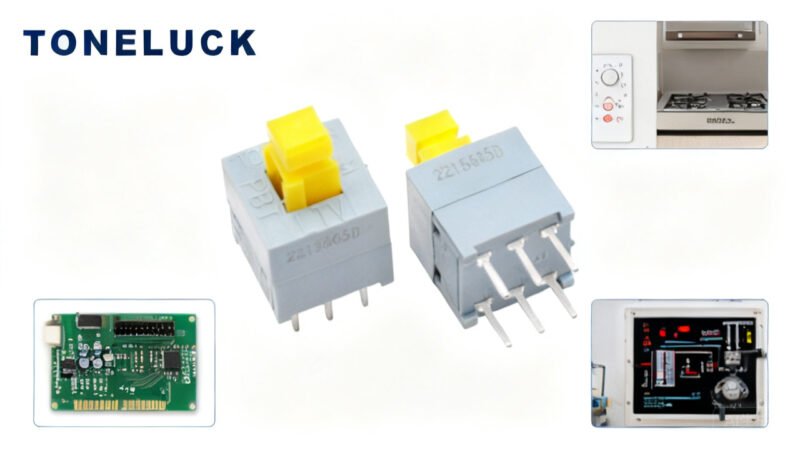
In the intricate world of industrial automation, consumer electronics, and specialized equipment, the seemingly small micro switch plays a monumental role. Often overlooked, these diminutive components are the silent workhorses, ensuring precise control, reliable operation, and critical safety functions across countless applications. For engineers, product designers, and procurement specialists, understanding the nuances of micro switches – from their fundamental mechanics to specialized variants like waterproof micro switches and miniature models – is paramount to building robust and efficient systems.
At its core, a micro switch, also known as a snap-action switch, is an electrical switch actuated by very little physical force, utilizing a snap-action mechanism. This mechanism ensures a rapid and definitive change in contact state, regardless of the speed of the actuator. This ‘snap’ provides several critical advantages: it minimizes arcing, extends contact life, and ensures consistent, repeatable operation, which is vital in precision applications.
The Indispensable Role of Micro Switches in Modern Design
Micro switches are not just simple on/off devices; they are precision instruments. Their applications span a vast spectrum:
- Industrial Automation: Position sensing, safety interlocks, control panels.
- Appliances: Door interlocks in microwaves, pressure sensing in washing machines.
- Automotive: Door latches, seat belt sensors, gearshift position detection.
- Medical Devices: Precision control in diagnostic equipment, patient beds.
- HVAC Systems: Damper control, fan speed regulation.
The reliability and compact nature of these switches make them indispensable.
Exploring Key Types and Their Applications
While the basic principle remains consistent, micro switches come in various forms, each tailored for specific environmental and functional demands:
Standard Micro Switches
These are the ubiquitous versions, found in a myriad of everyday and industrial devices. They offer a balance of size, force, and electrical ratings, making them suitable for general-purpose applications where environmental factors are not extreme.
Limit Switches: The Industrial Guardian
A limit switch is essentially a micro switch housed within a rugged enclosure, often featuring a specific actuator designed for detecting the presence or absence of an object, or for monitoring the limits of machine travel. These robust devices are critical in industrial settings for:
- Machine Safety: Ensuring guards are closed or parts are in place before operation.
- Position Control: Detecting the end of a conveyor belt, the open/closed state of a valve.
- Automation: Providing feedback to PLCs and control systems.
Their durability and ability to withstand harsh industrial environments make them a cornerstone of automation.
Waterproof Micro Switches: Defying the Elements
For applications exposed to moisture, dust, or other contaminants, a waterproof micro switch is non-negotiable. These switches feature enhanced sealing – often achieving IP67 or even higher ratings – to prevent ingress of liquids and particulates. Common applications include:
- Outdoor equipment (vending machines, security cameras).
- Automotive under-the-hood applications.
- Marine equipment.
- Medical devices requiring sterilization.
- Industrial machinery in washdown areas.
The integrity of their sealing is critical for long-term reliability in challenging conditions.
Miniature and Subminiature Micro Switches (e.g., MQS-9A Mini Micro Switch)
As devices become smaller and more compact, the demand for miniature components grows. Switches like the TONELUCK MQS-9A Mini Micro Switch exemplify this trend. These tiny powerhouses offer the same snap-action precision in a much smaller footprint, enabling designers to create sleeker, more portable, and space-efficient products. They are commonly found in:
- Consumer electronics (smartphones, wearables).
- Medical handheld devices.
- Compact industrial sensors.
- IoT devices where space is at a premium.
Critical Factors When Selecting a Micro Switch
Choosing the right micro switch is a meticulous process that requires careful consideration of several key parameters:
- Electrical Ratings: Match the switch’s voltage and current capabilities to the application’s requirements. Consider resistive, inductive, and motor loads.
- Actuator Type: Pin plungers, lever arms (straight, roller, simulated roller), and push buttons are common. The choice depends on the mechanism activating the switch.
- Operating Force: The force required to actuate the switch. This impacts user experience and sensitivity.
- Operating Temperature Range: Ensure the switch can perform reliably within the environmental temperature extremes of the application.
- Environmental Protection (IP Rating): For harsh environments, an appropriate IP (Ingress Protection) rating is crucial, especially for waterproof micro switch applications.
- Life Cycle: Both mechanical and electrical life cycles are important. High-quality switches can offer millions of operations.
- Contact Configuration: SPDT (Single Pole Double Throw) is common, but SPST (Single Pole Single Throw) or DPDT (Double Pole Double Throw) options exist.
- Mounting Options: PCB mounting, panel mounting, or chassis mounting.
- Certifications: UL, CE, RoHS compliance are often required for market entry and safety standards.
The Importance of a Reputable micro switch manufacturer
Partnering with an experienced micro switch manufacturer like TONELUCK is crucial for success. A leading manufacturer brings:
- Consistent Quality: Rigorous testing and quality control processes ensure reliable performance and longevity.
- Technical Expertise: Access to engineering support for application-specific challenges and custom solutions.
- Broad Product Portfolio: A wide range of standard, limit, waterproof, and miniature micro switch options, including specialized products like the MQS-9A.
- Reliable Supply Chain: Ensures consistent availability and on-time delivery.
- Innovation: Ongoing research and development to meet future demands for miniaturization, higher performance, and environmental resilience.
Conclusion
Micro switches are far more than simple components; they are critical enablers of functionality, safety, and precision in an increasingly automated and interconnected world. By carefully considering the application’s specific demands, understanding the various types available – from robust limit switches to delicate miniature and waterproof micro switches – and partnering with a trusted micro switch manufacturer, engineers can ensure their designs achieve optimal performance, durability, and reliability for years to come.
