
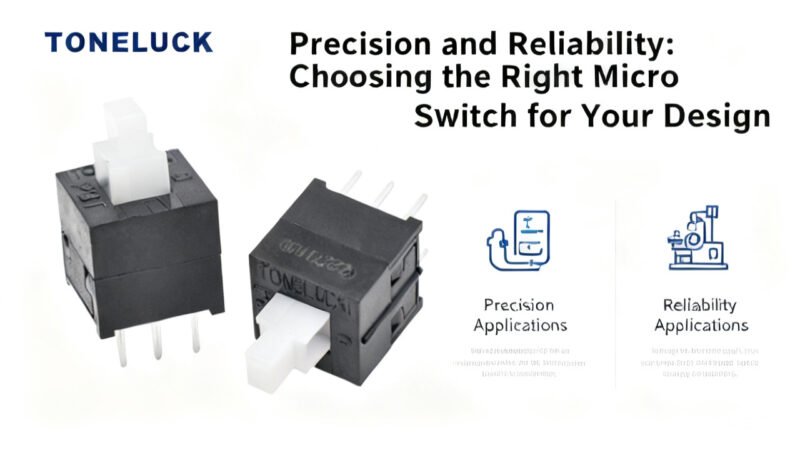
In the intricate world of industrial automation, consumer electronics, and automotive systems, the humble micro switch often acts as an unsung hero. These compact, snap-action devices are critical for sensing position, detecting limits, and providing essential control signals. However, with a vast array of options available from various micro switch manufacturers, selecting the optimal component for a specific application requires a meticulous understanding of their characteristics and potential impact on system performance and longevity.
This guide aims to demystify the selection process, providing engineers and product developers with the knowledge to make informed decisions, ensuring both precision and long-term reliability in their designs. From standard models to specialized waterproof micro switches and robust limit switches, understanding the nuances is key to preventing costly failures and optimizing operational efficiency.
Understanding the Core: What is a Micro Switch?
At its heart, a micro switch is a small, sensitive snap-action switch that makes or breaks an electrical circuit with a rapid, decisive action, regardless of the speed of actuation. This “snap-action” mechanism is crucial, as it minimizes arcing and extends contact life, making them ideal for high-reliability applications. Typically, they consist of a spring-loaded lever or plunger, a set of contacts (normally open – NO, normally closed – NC, or changeover – CO/SPDT), and a robust housing.
Their versatility stems from their ability to handle various electrical loads, operate within tight tolerances, and offer multiple actuation methods. From simple on/off functions to complex interlock systems, micro switches are foundational components in countless devices.
Critical Parameters for Micro Switch Selection
1. Electrical Ratings: Voltage, Current, and Load Type
One of the foremost considerations is the switch’s ability to handle the electrical load. Engineers must specify both the maximum voltage (AC or DC) and current the switch will carry. Equally important is the type of load: resistive, inductive, or capacitive. Inductive loads (e.g., motors, solenoids) generate back EMF, which can cause arcing and prematurely degrade contacts. Therefore, switches designed for inductive loads often have specific contact materials or arc suppression features. Always ensure the switch’s rating exceeds the maximum anticipated load.
2. Actuator Type and Operating Characteristics
The actuator is the part of the switch that interacts with the external mechanism. Common types include:
- Pin Plunger: Direct actuation, often requiring precise alignment.
- Lever Actuators: Straight levers, roller levers, simulated roller levers. These offer mechanical advantage and can accommodate varying actuation angles or cam-driven systems. Roller levers are particularly useful for applications involving sliding motion or cams, reducing wear on the actuator itself.
Beyond the physical type, operating characteristics like operating force (OF), release force (RF), pre-travel (PT), overtravel (OT), and differential travel (DT) are vital. These define the force required to actuate the switch, the distance the actuator moves before contact change, and the distance between actuation and release points. For instance, the MQS-9A Mini Micro Switch, a popular choice, offers precise control over these parameters, making it suitable for compact, high-precision applications where space is at a premium.
3. Environmental Robustness: IP Ratings and Temperature
For applications in harsh or challenging environments, environmental protection is paramount. This is where the waterproof micro switch becomes indispensable. Ingress Protection (IP) ratings, such as IP67, indicate the switch’s resistance to dust and water. An IP67 rated switch is fully dust-tight and protected against immersion in water up to 1 meter for 30 minutes, making it suitable for outdoor machinery, automotive under-hood applications, or food processing equipment where washdowns are common. Operating temperature range is another critical factor; extreme heat or cold can affect switch performance and lifespan.
4. Mechanical and Electrical Life
The expected lifespan of a micro switch is measured in cycles. Mechanical life refers to the number of operations the switch can perform without electrical load before mechanical failure. Electrical life, on the other hand, specifies the number of operations under a rated electrical load. High-reliability applications demand switches with millions of cycles, ensuring long-term, maintenance-free operation. A reputable micro switch manufacturer will provide clear data on both.
5. Contact Material and Configuration
Contact material significantly impacts performance. Gold contacts are excellent for low-current, low-voltage (dry circuit) applications, offering superior reliability by resisting oxidation. Silver contacts, often silver alloy, are preferred for higher current applications due to their excellent conductivity and resistance to welding. The contact configuration (SPDT, SPST-NO, SPST-NC) dictates how the switch integrates into the circuit.
6. Mounting Options
Switches come in various mounting styles, including PCB mount, panel mount, and screw mount. The choice depends on the application’s physical constraints and assembly requirements. Some applications may require custom mounting brackets or enclosures.
7. Certifications and Standards
Compliance with international standards such as UL, CE, CQC, and RoHS is crucial for market acceptance and safety. These certifications assure that the component meets specific quality and safety benchmarks, reducing design risks and facilitating regulatory approvals for end products.
Beyond the Basic: Limit Switches and Specialized Micro Switches
While all limit switches utilize a micro switch internally, a limit switch is typically a more robust, enclosed device designed for industrial environments. They are primarily used for position detection, safety interlocks, and machine control in heavy-duty applications. A limit switch often features a larger, more durable housing, a robust actuator arm (e.g., roller plunger, rotary lever), and enhanced sealing against dust, oil, and water, making them ideal for factory automation, conveyors, and heavy machinery.
Specialized micro switches like the waterproof micro switch extend the utility of these devices into challenging environments where moisture, dust, or corrosive agents are present. These are essential for outdoor equipment, medical devices requiring sterilization, and automotive systems exposed to the elements.
Miniature micro switches, exemplified by models like the MQS-9A Mini Micro Switch, address the growing demand for compact components in ever-smaller electronic devices. Despite their diminutive size, they maintain the snap-action reliability and precision of their larger counterparts, making them suitable for consumer electronics, medical instruments, and complex control panels where space is a premium.
The Indispensable Role of a Reputable Micro Switch Manufacturer
Partnering with an experienced and reliable micro switch manufacturer is not merely about sourcing components; it’s about securing a foundation of quality, consistency, and technical support for your products. Manufacturers like TONELUCK, with decades of expertise, offer:
- Consistent Quality: Ensuring every batch of switches meets stringent performance and reliability standards.
- Technical Expertise: Providing valuable guidance on switch selection, application challenges, and custom solutions.
- Innovation: Developing new products like advanced waterproof micro switches or ultra-miniature designs to meet evolving industry needs.
- Global Compliance: Adhering to international safety and environmental regulations.
Choosing a manufacturer with a proven track record ensures that the components you integrate into your designs are not only high-performing but also backed by robust R&D and quality control processes. This partnership minimizes risks, accelerates development cycles, and ultimately enhances the reliability and market success of your end products.
Conclusion: Precision in Every Click
The selection of a micro switch, whether a standard model, a robust limit switch, or a specialized waterproof micro switch, is a critical engineering decision that profoundly impacts the performance, safety, and longevity of any system. By meticulously evaluating electrical ratings, actuator types, environmental protection, mechanical life, and supplier reliability, engineers can ensure they choose components that perfectly match their application’s demands.
Investing time in understanding these intricate details and collaborating with a trusted micro switch manufacturer ensures that the “click” of your chosen switch represents not just an electrical contact, but a testament to precision, reliability, and engineering excellence.
