
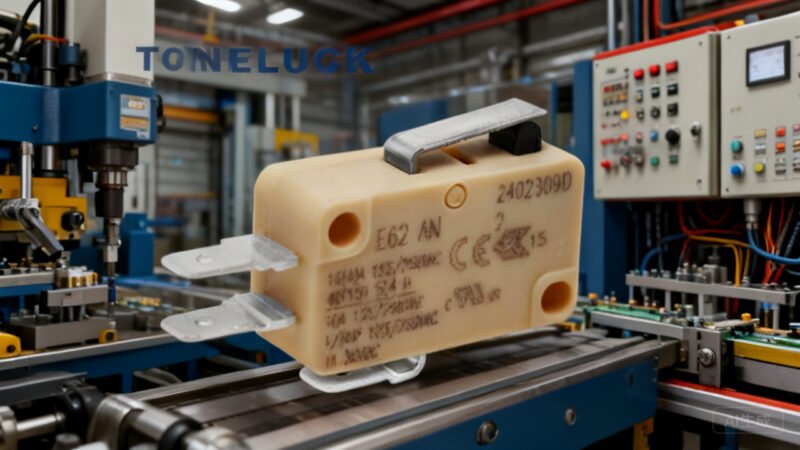
In the intricate world of modern engineering and industrial design, small components often hold disproportionately significant roles. Among these, the micro switch stands out as a fundamental, yet often overlooked, hero. These compact, snap-action switches are the silent workhorses behind countless mechanisms, ensuring precision, reliability, and safety across an astonishing array of applications, from consumer electronics to heavy industrial machinery.
A micro switch, technically known as a miniature snap-action switch, operates on a simple yet highly effective principle. It employs a sensitive actuating mechanism that, when a minimal amount of force is applied, causes a rapid and decisive transfer of electrical contacts from one position to another. This “snap-action” mechanism is crucial because it ensures a consistent, repeatable actuation point, minimizes arcing between contacts, and provides a clear audible and tactile feedback.
The core components typically include a spring-loaded lever or plunger, a set of contacts (common, normally open, normally closed), and an enclosed housing. This design allows for high repeatability and a long operational life, making them ideal for applications requiring frequent switching operations.
Key Characteristics and Benefits
- Precision and Repeatability: The snap-action mechanism guarantees that the switch actuates at nearly the exact same position every time, which is critical for precise control and measurement in automated systems.
- Durability and Longevity: Engineered for millions of cycles, micro switches are built to withstand rigorous use, offering exceptional mechanical and electrical life.
- Compact Size: Their miniature footprint allows integration into designs where space is at a premium, enabling smaller, more efficient products.
- High Current Capacity: Despite their small size, many micro switches are capable of handling significant electrical loads, making them versatile for various power control applications.
- Cost-Effectiveness: Their robust design and mass production make them an economical choice for reliable switching solutions.
Types and Specialized Applications
The Critical Role of Limit Switches
A specific and widely recognized application of micro switch technology is the limit switch. These devices are indispensable in industrial automation, serving as critical components for detecting the presence or absence of an object, or for monitoring the limits of motion for machinery. For instance, in a conveyor system, a limit switch can detect when a product reaches the end of the line, triggering the next stage of the process or stopping the conveyor. In robotics, they define the safe operational boundaries of robotic arms, preventing overextension and potential damage.
Limit switches are often housed in robust enclosures to protect them from harsh industrial environments, featuring various actuator types (roller levers, plungers, whiskers) to suit different mechanical interfacing needs. Their reliability in providing binary feedback (on/off) makes them foundational to safety interlocks and sequence control in automated manufacturing.
Navigating Harsh Environments with Waterproof Micro Switches
Not all applications occur in controlled, clean environments. Industries such as marine, automotive, outdoor equipment, and even some medical devices demand components that can withstand exposure to liquids, dust, and corrosive agents. This is where the waterproof micro switch becomes indispensable.
These specialized micro switches feature enhanced sealing mechanisms, often employing epoxy resin potting, O-rings, or fully encapsulated housings, to achieve high Ingress Protection (IP) ratings (e.g., IP67, IP68). An IP67 rated switch, for example, is dust-tight and can withstand immersion in water up to 1 meter for 30 minutes. This level of protection ensures consistent performance and extends the lifespan of the switch in challenging conditions, preventing electrical failures and maintaining operational integrity.
Critical Applications Across Industries
The versatility of micro switches is evident in their widespread adoption across numerous sectors:
- Automotive: Found in door latches, seat belt detection, gear shift interlocks, power window controls, and engine management systems.
- Industrial Automation: Essential for safety interlocks on machinery guards, position sensing in CNC machines, conveyor system control, and robotics.
- Home Appliances: Used in microwave oven door interlocks, washing machine lid switches, refrigerator ice makers, and vacuum cleaner power controls.
- Medical Devices: Integral to patient beds, diagnostic equipment, infusion pumps, and surgical tools for precise control and safety.
- HVAC Systems: Employed in fan controls, damper position sensing, and pressure switches.
- Security Systems: Utilized in alarm systems for door/window contact sensing and tamper detection.
Selecting the Optimal Micro Switch
Choosing the right micro switch for a specific application requires careful consideration of several factors:
- Electrical Ratings: Voltage and current capacity (AC/DC) must match the application’s requirements.
- Operating Force and Travel: The force required to actuate the switch and the distance the actuator travels are critical for mechanical design.
- Environmental Conditions: Temperature range, humidity, vibration, shock, and the need for ingress protection (e.g., waterproof micro switch) are paramount.
- Actuator Type: Plungers, roller levers, simulated rollers, and wire levers offer different interfacing options.
- Terminal Type: Solder terminals, quick-connect terminals, and wire leads provide various connection methods.
- Mechanical and Electrical Lifespan: Evaluate the expected number of cycles the switch needs to endure.
- Compliance and Certifications: Ensure the switch meets relevant industry standards (e.g., UL, CE, CQC).
The Mark of a Quality micro switch manufacturer
The performance and reliability of a micro switch are directly tied to the expertise and quality control of its manufacturer. A reputable micro switch manufacturer invests heavily in research and development, utilizing advanced materials and precision manufacturing processes to produce switches that meet stringent performance criteria. They offer a diverse product portfolio, including standard, miniature, and subminiature options, alongside specialized solutions like the MQS-9A Mini Micro Switch, known for its compact size and robust performance in demanding applications.
Manufacturers like TONELUCK, with a strong commitment to innovation and quality, provide not just components, but solutions that empower engineers to build more reliable, efficient, and safer systems. Their focus on custom solutions and rigorous testing ensures that each switch delivers consistent, long-term performance.
Conclusion
From the subtle click in a car door to the precise positioning in a robotic arm, micro switches are foundational to the functionality and safety of countless modern technologies. Their ability to deliver reliable, repeatable, and precise electrical switching in a compact and durable form factor makes them indispensable. As technology continues to advance, the demand for ever more sophisticated and resilient micro switches will only grow, solidifying their position as a cornerstone of industrial and consumer innovation.
