
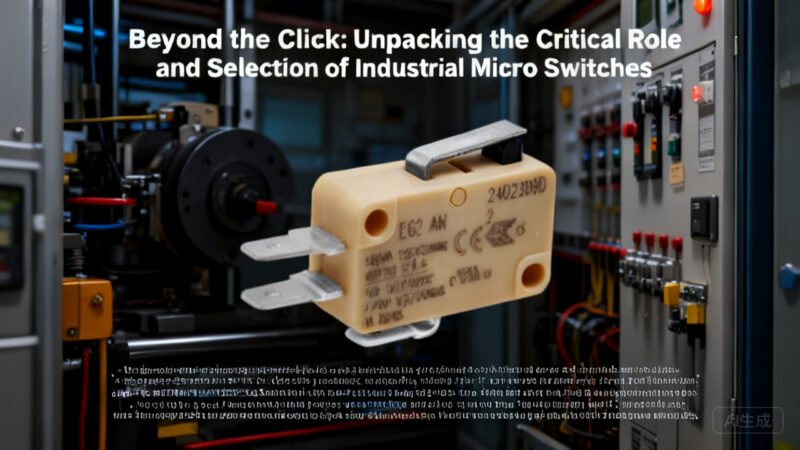
In the intricate world of industrial automation, consumer electronics, and countless other applications, a seemingly small component often performs a colossal task: the micro switch. These compact, snap-action devices are fundamental to detecting position, ensuring safety, and controlling complex sequences in machinery and systems globally. Operating on a simple principle of rapid contact change, micro switches provide reliable on/off signaling, making them the silent workhorses behind much of our modern technological infrastructure.
Understanding the Diverse Landscape of micro switches
While the core function remains consistent, micro switches come in a vast array of configurations, each optimized for specific operational demands and environmental conditions. Understanding these variations is crucial for proper integration and long-term performance.
Standard Micro Switches
The most common form, standard micro switches, are characterized by their precision snap-action mechanism, which ensures a quick and decisive change of contact state regardless of the speed of actuation. They are widely used in general control applications, from office equipment to industrial controls, where reliable open/close signals are paramount.
Limit Switches: Precision in Position Sensing
A specialized application of micro switch technology, limit switches are designed to detect the presence or absence of an object, or to monitor the position of moving parts in industrial machinery. They are robustly built, often housed in protective enclosures, and feature various actuator types (e.g., roller levers, plungers) to suit different mechanical interfaces. Limit switches are critical for safety interlocks, automated assembly lines, and machine tool control, providing precise feedback on the operational status of equipment.
Waterproof Micro Switches: Conquering Harsh Environments
For applications exposed to moisture, dust, oils, or other contaminants, waterproof micro switches are indispensable. These switches are engineered with advanced sealing techniques, often meeting stringent Ingress Protection (IP) ratings (e.g., IP67), to prevent the entry of foreign substances that could compromise performance or lead to failure. They are vital in outdoor equipment, automotive systems, marine applications, and food processing machinery where environmental resilience is non-negotiable.
Mini Micro Switches: Maximizing Space Efficiency
As devices become increasingly compact, the demand for smaller components grows. Mini micro switches, such as the MQS-9A Mini Micro Switch type, offer the same reliable snap-action functionality in significantly reduced footprints. Their diminutive size makes them ideal for applications with severe space constraints, including portable electronics, miniature medical devices, and intricate automation modules, without sacrificing performance or durability.
Key Selection Criteria for Optimal Performance
Choosing the right micro switch is not a one-size-fits-all decision. A thorough evaluation of several key parameters is essential to ensure the switch meets the application’s specific requirements and delivers sustained reliability.
Electrical Ratings
This includes the maximum voltage and current the switch can safely handle, as well as the type of load (resistive, inductive, lamp). Overrating can lead to premature failure, while underrating can cause contact welding or poor contact performance. Always select a switch with ratings that exceed the anticipated operational loads.
Actuator Types
The actuator is the part of the switch that interacts with the object being detected. Common types include pin plungers, lever arms (straight, roller, simulated roller), and push buttons. The choice depends on the available operating force, desired travel, and the mechanical interface of the application.
Operating Force & Travel
The operating force is the amount of pressure required to actuate the switch. This must be carefully matched to the force available from the activating mechanism. Similarly, pre-travel, over-travel, and differential travel are critical for precise timing and reliable operation.
Mechanical & Electrical Life
These specifications indicate the expected number of operations before failure. Mechanical life refers to the physical durability of the switch mechanism, while electrical life relates to the durability of the contacts under electrical load. For high-cycle applications, switches with extended life cycles are imperative.
Environmental Resistance
Beyond waterproofing, consider resistance to temperature extremes, vibration, shock, and corrosive agents. Switches designed for harsh industrial environments will feature robust housing materials and sealed construction to withstand these challenges.
Material Composition
The material of the contacts (e.g., silver alloy, gold plating for low current) and the housing (e.g., thermoplastic, metal) significantly impact performance and longevity. Ensure these materials are appropriate for the electrical load and environmental conditions.
Form Factor & Mounting
The physical dimensions, mounting holes, and terminal configurations (e.g., solder, quick-connect, screw) must align with the design constraints and assembly processes of the end product.
Applications Across Industries
The versatility of micro switches allows them to be integrated into an astonishing range of products and systems:
- Industrial Automation: Robotics, conveyor systems, safety interlocks on machine guards, process control.
- Automotive: Door latches, seatbelt detection, gear shift mechanisms, brake light actuation, power window controls.
- Consumer Appliances: Microwaves, washing machines, refrigerators, thermostats, coffee makers.
- Medical Devices: Diagnostic equipment, patient beds, infusion pumps, surgical tools.
- HVAC Systems: Damper control, fan speed detection, pressure switches.
- Security Systems: Door/window sensors, alarm triggers.
Partnering with a Reliable micro switch manufacturer
The performance and longevity of your product often hinge on the quality of its components. Partnering with a reputable micro switch manufacturer is paramount. Look for manufacturers with a proven track record of producing high-quality, consistent products that meet international standards (e.g., UL, CQC, ENEC). A reliable manufacturer will offer comprehensive technical specifications, responsive customer support, and the ability to provide custom solutions if needed. Their commitment to stringent quality control processes ensures that each switch delivers dependable operation, reducing the risk of costly downtime and product recalls.
The Future of Micro Switch Technology
Innovation continues to drive advancements in micro switch technology. Trends include further miniaturization to support increasingly compact devices, enhanced sealing for even more extreme environments, and the integration of smart features for diagnostic capabilities and predictive maintenance. As industries demand greater efficiency, reliability, and precision, micro switches will continue to evolve, remaining a cornerstone of control and sensing solutions.
Conclusion
Micro switches, though small, are mighty. Their widespread application across diverse sectors underscores their critical importance in ensuring the safe, efficient, and reliable operation of countless devices and systems. By carefully considering the myriad of options available and aligning switch specifications with application demands, engineers and product developers can harness the full potential of these indispensable components. Selecting the right micro switch is not merely a technical decision; it’s an investment in the performance, safety, and longevity of your end product.
