
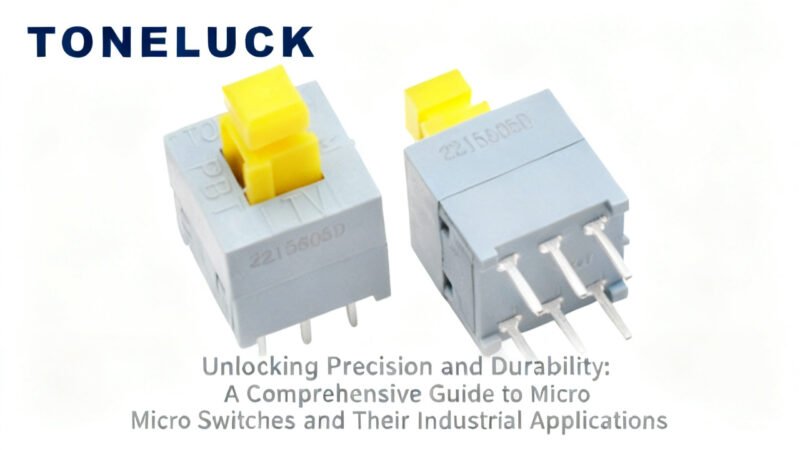
In the vast landscape of industrial control and automation, few components are as indispensable yet often overlooked as the micro switch. These tiny, precision-engineered devices are the unsung heroes behind countless operations, silently ensuring safety, efficiency, and reliability across an astonishing array of applications. For businesses striving for operational excellence, understanding the nuances of micro switches, from their fundamental design to specialized variants like limit switches and waterproof models, is crucial.
At its heart, a micro switch is a small, sensitive snap-action switch designed to rapidly make or break an electrical connection with a minimal amount of force. Its defining characteristic is the “snap-action” mechanism, which provides a fast, decisive change in contact state, independent of the actuator’s speed. This ensures consistent performance, reduces arcing, and extends operational life. They typically feature an actuator (a button, lever, or roller) that, when depressed by a small amount of travel, causes the internal contacts to switch states quickly and reliably. This precision makes them ideal for applications requiring accurate position detection and repeatable switching.
Ubiquitous Applications Across Industries
The versatility of micro switches means they are found almost everywhere. In the automotive industry, they detect seatbelt engagement, door closure, and pedal position. In home appliances, they ensure safety in microwaves, control washing machine cycles, and regulate refrigerator doors. For industrial automation, they are critical for machine safety interlocks, conveyor system control, and precise positioning of robotic arms. Medical devices, HVAC systems, and even complex aerospace equipment rely on the dependable feedback provided by these compact components. Their ability to handle diverse electrical loads and operate reliably in various environmental conditions makes them a cornerstone of modern technological infrastructure.
Enhanced Durability: The Role of Limit Switches
While all micro switches are designed for precision, some applications demand even greater robustness and higher electrical ratings. This is where limit switches come into play. Essentially, a limit switch is a type of micro switch housed in a rugged enclosure, often designed to withstand harsh industrial environments, significant mechanical forces, and higher current loads. They are primarily used to detect the presence or absence of an object, or to monitor the limits of travel for moving parts in machinery. For instance, in manufacturing plants, limit switches ensure that a robotic arm doesn’t extend beyond its safe operating range or that a conveyor belt stops when a product reaches a specific point. Their robust construction, typically featuring metal housings and heavy-duty actuators, makes them indispensable for safety systems and process control in heavy industry, construction equipment, and large-scale automation.
Conquering Harsh Environments: Waterproof Micro Switches
Not all operational environments are clean and dry. Industries such as marine, food processing, outdoor equipment, and even certain medical applications frequently expose electronic components to moisture, dust, oils, and other contaminants. For these challenging scenarios, waterproof micro switches are an absolute necessity. These specialized switches are engineered with advanced sealing techniques, often meeting stringent IP (Ingress Protection) ratings like IP67, indicating full protection against dust ingress and the effects of temporary immersion in water. A high-quality waterproof micro switch ensures consistent performance and extended lifespan, preventing short circuits, corrosion, and operational failures that can arise from environmental exposure. Their sealed construction makes them ideal for applications ranging from outdoor vending machines and industrial wash-down areas to marine navigation systems and medical diagnostic equipment where hygiene and reliability are paramount.
The Manufacturer’s Edge: Partnering for Performance
The reliability of any system is only as good as its weakest component. When it comes to micro switches, the choice of micro switch manufacturer is paramount. A reputable manufacturer doesn’t just produce switches; they engineer solutions. They invest heavily in research and development, employ rigorous quality control processes, and offer a wide range of products designed to meet diverse industrial needs. For example, a leading brand like TONELUCK micro switch is recognized for its commitment to innovation and manufacturing excellence, delivering high-performance components that stand the test of time.
Consider the MQS-9A Mini Micro Switch from TONELUCK. This particular model exemplifies how advanced engineering can address specific market demands. Its compact size makes it ideal for miniaturized devices where space is at a premium, without compromising on the critical snap-action reliability or electrical performance. Such specialized products highlight the importance of partnering with a manufacturer that understands specific application challenges and can provide tailored solutions, whether it’s for ultra-compact integration, extreme environmental resilience, or high-cycle longevity.
Key Considerations When Selecting a Micro Switch
Choosing the right micro switch involves more than just selecting a model. Engineers and procurement professionals must evaluate several critical factors:
- Electrical Rating: Ensure the switch can handle the required voltage and current without degradation.
- Operating Force: Match the switch’s actuation force to the application’s mechanical input.
- Actuator Type: Select from pin plungers, lever arms, roller levers, and more, based on the mechanical interface.
- Lifespan (Mechanical & Electrical): Consider the number of cycles the switch is rated for, especially in high-frequency applications.
- Environmental Sealing: For harsh conditions, IP ratings are crucial (e.g., IP67 for waterproof micro switches).
- Operating Temperature Range: Verify the switch’s ability to perform reliably under expected thermal conditions.
- Certifications: Look for industry standards and regulatory compliance (e.g., UL, CE, CQC).
Conclusion: The Indispensable Link in Industrial Integrity
Micro switches, in all their forms—standard, limit, and waterproof—are far more than simple electrical components. They are precision instruments that serve as critical feedback mechanisms, safety interlocks, and control interfaces, driving the reliability and efficiency of countless systems worldwide. For businesses operating in demanding industrial landscapes, investing in high-quality micro switches from a reputable micro switch manufacturer is not merely a purchasing decision; it’s a strategic imperative. By understanding their capabilities and carefully selecting the right product for each application, companies can ensure the seamless operation, enhanced safety, and long-term performance of their equipment and processes, ultimately contributing to sustained industrial excellence.
