
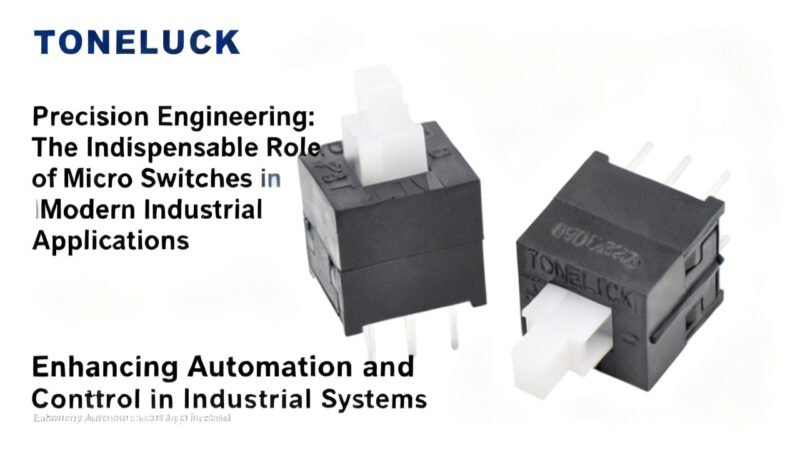
In the intricate world of industrial automation and advanced electronics, success often hinges on the performance of its smallest, yet most critical, components. Among these unsung heroes, the micro switch stands out as a fundamental device, pivotal for ensuring precise control, safety, and reliability across a myriad of applications. From robust machinery to delicate instrumentation, these compact components are the silent workhorses, translating mechanical motion into electrical signals with unparalleled accuracy.
At its core, a micro switch, also known as a miniature snap-action switch, is an electrical switch actuated by very little physical force, often involving a “snap” action. This distinctive snap mechanism ensures rapid contact closure or opening, independent of the actuator speed, which is crucial for preventing contact arcing and extending operational life. Typically, a micro switch consists of a spring-loaded lever or plunger, which, when depressed, causes an internal mechanism to quickly switch the electrical contacts between normally open (NO) and normally closed (NC) states. Their high precision, repeatability, and long mechanical life make them indispensable across various sectors.
Key Characteristics and Advantages for Industrial Use
- High Precision and Repeatability: micro switches are renowned for their consistent actuation points, making them ideal for applications requiring exact position sensing.
- Durability and Long Life: Engineered for millions of cycles, they offer exceptional longevity, even in demanding industrial environments.
- Compact Size: Their small footprint allows for integration into space-constrained designs, facilitating miniaturization in modern devices.
- Versatility: Available in numerous configurations, including various actuator types (plunger, lever, roller lever), contact arrangements (SPDT, SPST), and electrical ratings.
- Cost-Effectiveness: Despite their critical role, micro switches are generally economical, offering a high return on investment through reliability and reduced downtime.
Diverse Applications Demand Diverse Micro Switches
The versatility of micro switches is reflected in the wide array of types available, each tailored for specific operational demands:
- Standard Micro Switches: The foundational design, offering reliable snap-action switching for general-purpose applications.
- Limit Switches: A specialized form of micro switch, limit switches are designed to detect the presence or absence of an object, or to monitor the travel limits of machinery. They are robust, often housed in protective enclosures, and crucial for safety and automation in heavy industrial settings, ensuring machinery does not exceed predefined operational boundaries.
- Waterproof Micro Switches: For environments exposed to moisture, dust, or harsh chemicals, waterproof micro switches are essential. These switches feature sealed enclosures (often IP67 rated or higher) that protect the internal contacts from contaminants, ensuring reliable operation in outdoor equipment, marine applications, and washdown areas.
- Miniature and Subminiature Micro Switches: As devices become smaller, the demand for compact components grows. Miniature micro switches, such as the MQS-9A Mini Micro Switch, are designed for applications where space is at a premium without compromising performance. These tiny powerhouses are critical in consumer electronics, small appliances, and portable medical devices, offering precise control in a diminutive package.
Where Micro Switches Make a Difference
The reach of micro switches extends across virtually every industry:
- Industrial Automation: Used as position sensors, safety interlocks on machinery doors, and end-of-travel detectors for robotic arms and conveyor systems. Limit switches are particularly vital here.
- Automotive: Found in car door latches, seat belt buckles, gear shifters, and various engine control systems, providing critical feedback to the vehicle’s ECU.
- HVAC Systems: Employed in thermostats, damper controls, and pressure switches to regulate temperature and airflow.
- Medical Devices: Essential for precise control in diagnostic equipment, surgical tools, and patient monitoring systems, where reliability is paramount.
- Consumer Electronics: From microwave ovens and washing machines to gaming controllers and printers, micro switches enable user interaction and internal mechanisms.
- Aerospace: Used in landing gear, cockpit controls, and access panel detection, where extreme reliability and durability are non-negotiable.
Selecting Your micro switch manufacturer: A Critical Decision
The performance and longevity of your product often depend on the quality of its components. When selecting a micro switch manufacturer, several factors are paramount:
- Quality and Reliability: Look for manufacturers with a proven track record of producing high-quality, durable switches that meet stringent industry standards. Certifications (e.g., UL, CQC, ENEC) are strong indicators of adherence to quality.
- Customization Capabilities: Many applications require specific actuator types, force requirements, or electrical ratings. A manufacturer capable of offering tailored solutions, such as those provided by experienced suppliers like TONELUCK micro switch, can be invaluable.
- Technical Support and Expertise: Access to knowledgeable engineers who can assist with design integration, troubleshooting, and application-specific advice is crucial.
- Supply Chain Stability: Ensure the manufacturer has robust production capabilities and a reliable supply chain to meet your volume requirements and delivery schedules.
- Environmental Compliance: Verify adherence to regulations such as RoHS and REACH, especially for products destined for international markets.
The MQS-9A Mini Micro Switch: A Glimpse into Miniaturized Precision
The MQS-9A Mini Micro Switch exemplifies the advancements in micro switch technology. Designed for applications demanding both compactness and high performance, this type of switch offers a robust solution for space-constrained designs. Its features typically include a low operating force, high electrical ratings relative to its size, and a long operational life, making it suitable for intricate mechanisms in consumer gadgets, automotive interiors, and specialized industrial tools. The ability to deliver precise, repeatable action in such a small form factor underscores the innovation driving the micro switch industry.
The Future of Micro Switches
The evolution of micro switches continues, driven by the increasing demands of smart technologies and miniaturization:
- Enhanced Miniaturization: Even smaller switches with higher performance capabilities will emerge to meet the needs of increasingly compact devices.
- Integrated Intelligence: Future micro switches may incorporate smart features, offering diagnostic capabilities or direct digital interfaces.
- Advanced Materials: Development of new materials will lead to switches with improved resistance to extreme temperatures, chemicals, and vibration, further expanding their application range.
- Wireless Integration: While still nascent, the concept of integrating wireless communication into certain sensing components could eventually impact the micro switch landscape for specific applications.
Conclusion: The Unseen Power of Precision
Micro switches, in their various forms – from robust limit switches detecting machinery limits to sealed waterproof micro switches enduring harsh conditions, and the incredibly compact MQS-9A Mini Micro Switch enabling miniature designs – are more than just simple components. They are critical enablers of precision, safety, and reliability across the industrial and consumer landscapes. For engineers and product designers, understanding the nuances of these switches and partnering with a reputable micro switch manufacturer is not merely a choice but a strategic imperative. As technology advances, the humble micro switch will undoubtedly continue to play an essential, albeit often unseen, role in shaping the future of innovation.
