
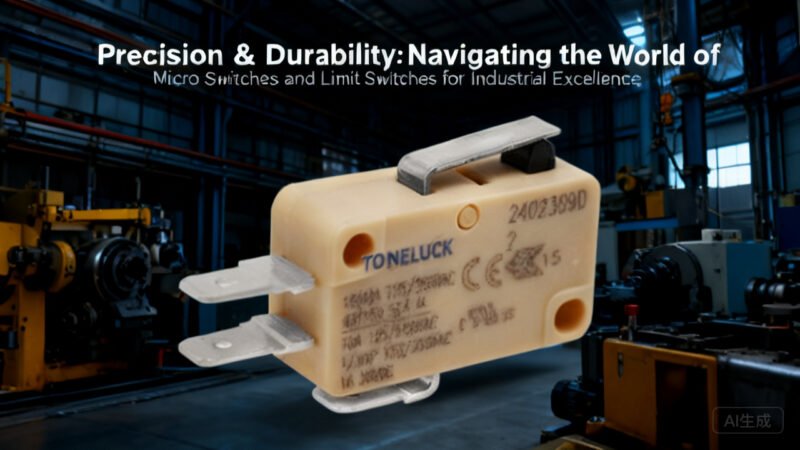
micro switches, though small in stature, play a colossal role in the functionality and safety of countless industrial and consumer products. These seemingly simple electromechanical devices are the unsung heroes behind precise control, reliable sensing, and critical safety interlocks across diverse applications. For B2B stakeholders – engineers, product designers, procurement specialists, and manufacturers – a deep understanding of micro switch technology, its variations, and the nuances of selection is paramount to ensuring product longevity, performance, and compliance. This article delves into the intricate world of micro switches, their close relatives, limit switches, and the critical factors in choosing the right components and manufacturers for your next project.
What is a Micro Switch?
At its core, a micro switch (often referred to as a miniature snap-action switch) is an electrical switch actuated by very little physical force, utilizing a snap-action mechanism. This mechanism ensures a rapid, decisive transfer of contacts from one position to another, regardless of the speed of actuation. This “snap-action” is crucial for preventing arcing and ensuring consistent, reliable operation over millions of cycles. Typically, a micro switch consists of a spring-loaded lever or plunger, which, when depressed, causes an internal mechanism to quickly open or close an electrical circuit. Their compact size, high repeatability, and durability make them indispensable in applications requiring precise detection of position or presence.
The Broader Family: Understanding Limit Switches
While often used interchangeably in common parlance, a limit switch is essentially a type of micro switch designed specifically for industrial applications, primarily to detect the presence or absence of an object, or to monitor the travel limits of moving machinery. Limit switches are robust, often housed in durable enclosures, and feature a variety of actuators (e.g., roller plungers, rotary levers, fork levers) to suit different mechanical interfacing needs. They are fundamental to industrial automation, machine safety, and process control, acting as critical feedback devices to PLCs (Programmable Logic Controllers) and control systems. The distinction often lies in the application environment and the overall packaging, with limit switches generally engineered for more demanding industrial conditions.
Key Features and Considerations for Industrial Applications
Selecting the appropriate switch requires a meticulous evaluation of several parameters:
- Actuation Force and Travel: The force required to operate the switch and the distance the actuator must travel are critical for integration into mechanical systems. Precision applications demand switches with low operating force and minimal pre-travel.
- Electrical Ratings: This includes voltage (AC/DC) and current ratings. Over-specifying can lead to unnecessary cost, while under-specifying can result in switch failure, arcing, and safety hazards.
- Operating Temperature Range: Industrial environments can be harsh. Switches must be able to perform reliably across the expected temperature extremes without degradation of materials or performance.
- Mechanical and Electrical Life: Measured in cycles, these specifications indicate the switch’s durability. High-cycle applications, like those found in assembly lines, demand switches with an extended lifespan, often in the tens of millions of cycles.
- Environmental Protection: For many industrial and outdoor applications, protection against dust, water, and other contaminants is non-negotiable. This is where a waterproof micro switch becomes essential. Switches rated IP67 or higher offer robust protection, ensuring reliable operation even when exposed to splashing water, jets, or temporary immersion. This prevents corrosion and short circuits, extending the operational life of the equipment.
- Size and Form Factor: Miniaturization is a continuous trend in electronics. Compact designs allow for greater design flexibility and integration into smaller devices. The MQS-9A Mini Micro Switch, for instance, exemplifies how advanced engineering can deliver high performance in a remarkably small footprint, making it ideal for space-constrained applications without compromising reliability.
- Contact Material: The choice of contact material (e.g., silver alloy, gold plating) impacts electrical performance, contact resistance, and life, especially for low-current or high-frequency switching.
Selecting the Right micro switch manufacturer
The reliability of your end product is inextricably linked to the quality of its components. Choosing a reputable micro switch manufacturer is therefore a strategic decision.
- Quality and Consistency: Look for manufacturers with rigorous quality control processes, certifications (e.g., ISO 9001, IATF 16949 for automotive), and a proven track record of producing consistent, high-quality components.
- Technical Expertise and Support: A good manufacturer provides comprehensive technical data, application support, and engineering assistance to help you select and integrate their products effectively.
- Customization Capabilities: Many industrial applications have unique requirements. A manufacturer capable of offering custom designs, specific actuator types, or tailored electrical characteristics can be a significant asset.
- Global Reach and Supply Chain Reliability: Especially for large-scale operations, ensuring a stable and reliable supply chain is crucial.
- Innovation: Partnering with manufacturers who invest in R&D ensures access to the latest advancements in switch technology.
For example, a TONELUCK micro switch is often recognized in the industry for its commitment to precision engineering and durability, offering a wide range of switches that meet stringent industrial standards, including specialized waterproof micro switch options and compact designs like the MQS-9A Mini Micro Switch. Their focus on quality and innovation positions them as a strong contender for demanding B2B applications.
Applications Across Industries
Micro switches and limit switches are ubiquitous:
- Automotive: Door interlocks, seatbelt detection, gear shift position sensing.
- Industrial Control: Machine tools, robotics, conveyor systems, safety gates, elevator systems.
- Home Appliances: Microwaves, washing machines, refrigerators, HVAC systems.
- Medical Devices: Diagnostic equipment, patient beds, fluid dispensing systems.
- IoT Devices: Smart sensors, automated blinds, security systems.
Future Trends
The evolution of micro switches continues with trends towards:
- Further Miniaturization: Enabling integration into even smaller and more complex systems.
- Enhanced Connectivity: Integration with smart systems and IoT platforms.
- Increased Durability and Environmental Resistance: Pushing the boundaries of operating conditions, making waterproof micro switch technology more robust and accessible.
- Advanced Materials: Improving performance, lifespan, and resistance to extreme conditions.
Conclusion
The seemingly simple click of a micro switch belies its critical importance in modern industrial and electronic design. From ensuring the safe operation of heavy machinery with robust limit switch mechanisms to enabling precise control in compact devices with components like the MQS-9A Mini Micro Switch, these components are foundational. By carefully considering technical specifications, environmental demands – particularly the need for a waterproof micro switch in harsh conditions – and by partnering with a reputable micro switch manufacturer like TONELUCK, businesses can ensure the longevity, reliability, and optimal performance of their products. Investing in high-quality switches is not just a component choice; it’s an investment in the integrity and success of your entire system.
