
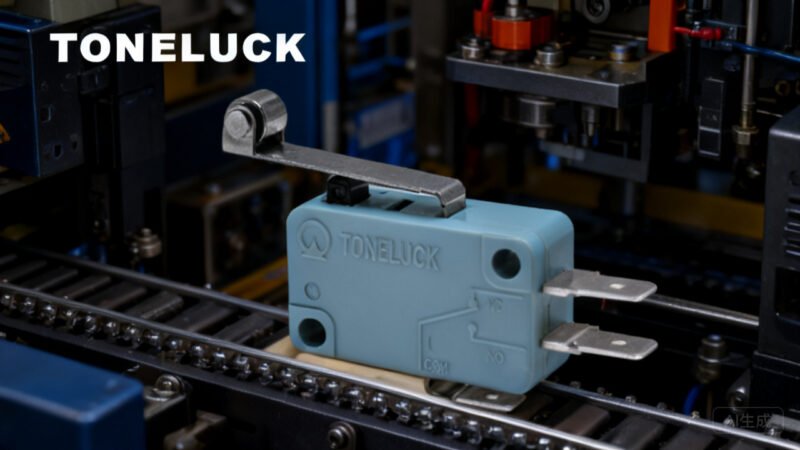
In the intricate world of industrial automation and sophisticated electronic devices, precision, reliability, and safety are paramount. Every movement, every detection, and every control signal must be executed flawlessly to ensure optimal performance and minimize downtime. At the heart of countless such operations lie two indispensable components: micro switches and limit switches.
These seemingly small devices play a monumental role in dictating the behavior of machinery, safeguarding operators, and enhancing overall system efficiency. For businesses striving for excellence in manufacturing, robotics, automotive, and consumer electronics, understanding the nuances of these critical components is not just beneficial—it’s essential for competitive advantage.
A micro switch, often referred to as a miniature snap-action switch, is an electromechanical device characterized by its extremely sensitive trigger and rapid contact transfer. Its design incorporates a highly precise internal spring mechanism that, upon activation by a small operating force, causes the contacts to “snap” from one position to another with very high repeatability and minimal travel.
This snap-action mechanism offers several distinct advantages:
- High Repeatability: Ensures consistent operation over millions of cycles, critical for precise control.
- Long Mechanical Life: Designed for durability, often exceeding tens of millions of cycles.
- Low Operating Force: Requires minimal force to actuate, making them suitable for sensitive applications.
- Quick Response Time: The rapid contact transfer minimizes arcing and extends electrical life.
micro switches are ubiquitous, finding applications in a vast array of products and systems. From detecting the closure of a microwave oven door or a car’s seatbelt buckle, to precise position sensing in industrial machinery and control panels, their versatility is unmatched. In the realm of compact design, models like the TONELUCK MQS-9A Mini Micro Switch exemplify how high precision can be integrated into remarkably small footprints, enabling sophisticated functionalities in increasingly miniaturized devices.
The Robustness of Limit Switches: Guardians of Industrial Position
While micro switches provide foundational precision, limit switches take this concept further into robust industrial environments. A limit switch is an electromechanical device that detects the presence or absence of an object, its position, or the end-of-travel of a moving part. Essentially, it “limits” the movement of a machine or system by providing an electrical signal when a certain physical limit is reached.
What differentiates a limit switch from a bare micro switch is often its robust enclosure and specialized actuator design, engineered to withstand the rigors of industrial settings such as dust, oil, coolant, and mechanical impact. They typically house one or more micro switch elements internally, protected by a durable housing.
Common types of limit switches include:
- Plunger Type: Actuated by direct contact with a moving part.
- Roller Lever Type: Features a roller at the end of a lever, allowing for detection of objects moving past it.
- Rod Type: Utilizes a flexible rod for detection in multiple directions.
- Rotary Type: Measures rotational movement or position.
Limit switches are cornerstones in applications like conveyor systems (detecting package presence), machine tools (determining tool position), robotics (defining arm travel limits), and safety gates (ensuring closure before operation). Their reliability in harsh conditions makes them indispensable for both automation and critical safety interlocks.
The Imperative of Waterproof Micro Switches: Conquering Challenging Environments
Not all operational environments are clean and dry. Industries such as marine, food processing, automotive (under-hood), outdoor equipment, and certain medical applications present significant challenges from moisture, dust, chemicals, and extreme temperatures. In these scenarios, standard switches simply won’t suffice, leading to premature failure, system downtime, and potential safety hazards.
This is where waterproof micro switches become not just an option, but a critical necessity. These specialized switches are designed with robust sealing mechanisms, often achieving high Ingress Protection (IP) ratings like IP67 or IP68. An IP67 rating signifies complete protection against dust ingress and protection against immersion in water up to 1 meter for 30 minutes, while IP68 offers protection against continuous immersion under specified conditions.
The benefits of deploying waterproof micro switches are substantial:
- Extended Lifespan: Protection against environmental contaminants significantly prolongs the switch’s operational life.
- Enhanced Reliability: Ensures consistent performance even in the most demanding conditions, reducing unexpected failures.
- Reduced Maintenance & Downtime: Fewer replacements and repairs translate directly into cost savings and increased productivity.
- Improved Safety: Prevents electrical shorts and malfunctions that could compromise operator safety or equipment integrity.
For applications where environmental resilience is non-negotiable, investing in high-quality waterproof micro switches is a strategic decision that pays dividends in long-term operational stability and safety.
Selecting the Right Switch: Key Considerations for Optimal Performance
Choosing the appropriate micro or limit switch for a given application requires a thorough understanding of several critical parameters. A mismatch can lead to suboptimal performance, frequent failures, or even catastrophic system breakdowns.
Electrical Requirements:
- Voltage and Current Ratings: Must match or exceed the circuit’s maximum voltage and current. Consider both AC and DC loads.
- Load Type: Resistive, inductive, or capacitive loads behave differently. Inductive loads (motors, solenoids) require switches with higher surge current capabilities.
- Contact Configuration: Normally Open (NO) or Normally Closed (NC), Single Pole Single Throw (SPST) or Single Pole Double Throw (SPDT).
Mechanical Requirements:
- Operating Force: The force required to actuate the switch.
- Pre-travel, Over-travel, and Differential Travel: These define the distances the actuator moves before actuation, after actuation, and the difference between actuation and release points, respectively. Critical for precise positioning.
- Actuator Type: Pin plunger, lever (straight, roller, simulated roller), push button, etc., depending on the mechanical interface.
- Mechanical Life: The number of operations the switch can withstand before mechanical failure.
Environmental Factors:
- Temperature Range: Operating and storage temperatures.
- Vibration and Shock Resistance: Especially important for mobile or heavy industrial machinery.
- Ingress Protection (IP Rating): Crucial for protection against dust and water.
- Chemical Resistance: If exposed to oils, solvents, or corrosive agents.
Form Factor and Mounting:
- Size Constraints: Dimensions must fit the available space.
- Mounting Options: Panel mount, PCB mount, screw mount, etc.
Certifications:
- Ensure compliance with relevant industry standards (e.g., UL, CE, RoHS, CQC) for safety and market access.
TONELUCK: A Partner in Precision Switching Solutions
As a seasoned micro switch manufacturer, TONELUCK understands the critical role these components play in diverse industries. With a steadfast commitment to quality, innovation, and customer satisfaction, TONELUCK offers a comprehensive range of micro switches, limit switches, and specialized waterproof micro switches designed to meet the most stringent performance requirements. Their expertise extends from standard, high-volume components to custom-engineered solutions for unique applications. The MQS-9A Mini Micro Switch is just one example of their dedication to providing reliable, compact, and high-performance solutions for today’s demanding technological landscape.
Conclusion
Micro switches and limit switches are far more than simple on/off devices; they are the vigilant sensors and precise actuators that enable complex systems to function reliably and safely. From the smallest consumer gadget to the largest industrial machine, their role is foundational. By carefully considering the specific demands of your application and partnering with experienced micro switch manufacturers like TONELUCK, businesses can ensure the longevity, efficiency, and safety of their products and operations, paving the way for sustained success in an increasingly automated world.
