
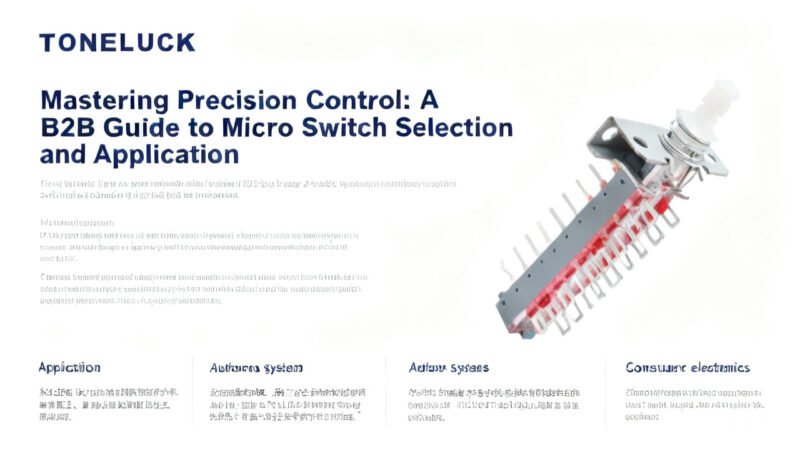
In the vast landscape of industrial automation, consumer electronics, and specialized equipment, the unassuming micro switch plays a profoundly critical role. These compact, highly sensitive devices are the unsung heroes of countless systems, providing precise control, reliable sensing, and essential safety interlocks. For businesses seeking to optimize performance, enhance safety, and ensure the longevity of their products, understanding the nuances of micro switches and partnering with a reputable micro switch manufacturer is paramount.
At its core, a micro switch, also known as a miniature snap-action switch, is an electrical switch actuated by very little physical force, utilizing a tipping-point mechanism that produces a rapid, decisive action. This snap-action mechanism is crucial for its reliability, ensuring consistent contact closure or opening regardless of the speed of actuation. Their small size, high durability, and repeatable operation make them indispensable across a spectrum of applications, from simple on-off functions to complex logic circuits.
Their versatility extends to detecting the presence or absence of objects, monitoring door closures, triggering safety mechanisms, and controlling fluid levels, among many other functions. The precision they offer is unmatched in their class, making them a preferred choice for applications where accuracy and consistency are non-negotiable.
Diverse Applications and Specialized Types
The utility of micro switches is incredibly broad, touching nearly every industry:
- Industrial Automation: Used in machinery for position sensing, safety gates, conveyor systems, and robotic arms.
- Automotive: Found in door latches, seat belt sensors, gear shifters, and power window controls.
- Home Appliances: Essential in microwaves, washing machines, refrigerators, and coffee makers for various sensing and control tasks.
- Medical Devices: Critical for safety interlocks, fluid control, and precise feedback in diagnostic and therapeutic equipment.
- HVAC Systems: Employed in fan controls, damper positioning, and temperature regulation.
Focus on Key Types:
While the basic principle remains, micro switches come in various specialized forms tailored for specific environments and tasks:
- Limit Switches: Often a larger, more robust variant of a micro switch, a limit switch is specifically designed to detect the presence or absence of an object, or to monitor the position of moving parts within a machine. They are vital for safety circuits, preventing over-travel, and initiating sequences in industrial machinery. Their sturdy construction often makes them suitable for harsh industrial environments.
- Waterproof Micro Switches: For applications exposed to moisture, dust, or other contaminants, a waterproof micro switch is essential. These switches feature enhanced sealing (often with an IP rating like IP67) to protect internal components from ingress. Industries such as marine, outdoor equipment, and food processing heavily rely on these robust solutions to maintain operational integrity and extend device lifespan in challenging conditions.
- Miniature and Subminiature Micro Switches: As devices become smaller and more integrated, the demand for compact switching solutions grows. Products like the MQS-9A Mini Micro Switch exemplify this trend, offering high performance in a significantly reduced footprint. These miniature versions are crucial for consumer electronics, portable devices, and any application where space is at a premium without compromising reliability.
The Imperative of Partnering with a Quality micro switch manufacturer
The performance of an entire system can hinge on the reliability of its smallest components. This makes the selection of a micro switch manufacturer a strategic decision, not merely a procurement task. A reputable manufacturer offers more than just switches; they provide expertise, consistency, and support.
- Reliability and Lifespan: High-quality micro switches are engineered for millions of cycles. A manufacturer like TONELUCK, known for producing the TONELUCK micro switch line, invests in rigorous testing and quality control to ensure their products meet demanding mechanical and electrical lifespans. This translates directly to reduced downtime and lower maintenance costs for your equipment.
- Precision and Repeatability: Consistent actuation force, precise operating position, and minimal differential travel are hallmarks of superior design. These factors are critical for applications requiring exact timing and feedback.
- Customization and Support: Leading manufacturers understand that off-the-shelf solutions don’t always fit every unique application. They offer customization options for actuators, terminals, electrical ratings, and housing materials. Furthermore, strong technical support can guide you through complex design challenges, ensuring the optimal switch for your specific needs.
- Compliance and Certifications: Adherence to international standards (e.g., UL, cUL, ENEC, CQC) is a testament to product safety and quality. A trusted manufacturer will provide products that meet these critical certifications, simplifying your product’s global market access.
Critical Considerations for Micro Switch Selection
Choosing the right micro switch involves evaluating several key parameters:
- Electrical Ratings: Match the switch’s voltage and current ratings to your application’s requirements to prevent premature failure and ensure safe operation.
- Operating Force: The force required to actuate the switch. This is critical for applications where very light touch (e.g., in sensitive instruments) or higher resistance (e.g., in safety mechanisms) is needed.
- Mechanical and Electrical Lifespan: The number of cycles the switch can withstand. Mechanical lifespan refers to physical actuation, while electrical lifespan considers the load being switched. Look for switches rated for millions of cycles for long-term reliability.
- Actuator Type: Plunger, lever, roller lever, simulated roller lever, and more. The actuator determines how the switch interacts with the object it’s sensing.
- Terminal Type: Solder, quick connect, screw, or wire leads. This impacts ease of installation and connection integrity.
- Environmental Sealing (IP Rating): Particularly important for a waterproof micro switch. An IP67 rating, for instance, indicates protection against dust and immersion in water up to 1 meter for 30 minutes.
- Operating Temperature Range: Ensure the switch can perform reliably within the ambient temperature of your application.
Conclusion: The Small Component with Big Impact
Micro switches, including their specialized forms like limit switches and waterproof micro switches, are foundational components that enable precision, safety, and efficiency across a vast array of industries. Their small size belies their profound impact on system functionality and reliability. For engineers and product developers, understanding the diverse types available, from the robust industrial limit switch to the compact MQS-9A Mini Micro Switch, is crucial.
Ultimately, the success of any design incorporating these vital components hinges on the quality and expertise of the chosen micro switch manufacturer. By prioritizing reliability, performance, and comprehensive support, businesses can ensure their products not only meet but exceed market expectations, fostering innovation and long-term operational excellence.
