
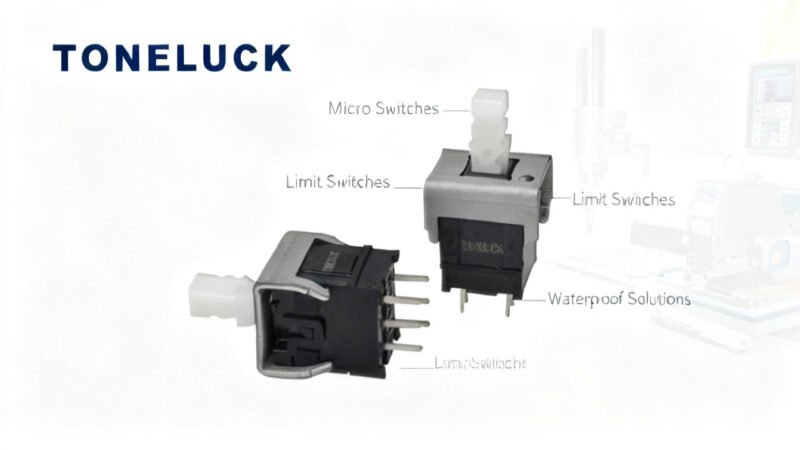
In the intricate world of industrial design and automation, the reliability of even the smallest components can dictate the success or failure of an entire system. Among these critical elements, micro switches stand out as unsung heroes, providing precise and dependable control across a vast spectrum of applications. These compact, snap-action devices are fundamental to ensuring safety, efficiency, and longevity in everything from consumer appliances to heavy machinery.
At its heart, a micro switch is a small, electromechanical device characterized by its “snap-action” mechanism. This unique design ensures that the movement of the actuator causes a rapid, decisive change in the state of its electrical contacts, regardless of the speed at which the actuator is pressed. This snap-action prevents slow make-and-break operations, which can lead to arcing and premature wear, thereby significantly extending the switch’s operational life and enhancing its reliability.
Typically comprising an actuator (like a pin plunger or lever), a spring mechanism, and a set of electrical contacts (often SPDT – Single Pole, Double Throw), micro switches offer high repeatability and precise operating points. Their robust construction and consistent performance make them indispensable in scenarios requiring accurate position sensing or reliable on/off control.
The Versatility of Applications
Micro switches are ubiquitous, found in countless devices and systems. They serve as safety interlocks in industrial doors, detect paper jams in printers, control temperature in thermostats, and act as door sensors in automotive systems. Their adaptability stems from the variety of actuator styles, contact configurations, and electrical ratings available, allowing them to be tailored to specific operational requirements.
Limit Switches: Precision in Position Detection
A specialized and critically important application of micro switch technology is the limit switch. Essentially, a limit switch is a micro switch housed in a robust enclosure, often designed for industrial environments, and equipped with a specific actuator (e.g., roller lever, plunger, wobble stick) to detect the presence or absence of an object, or to monitor the position of moving parts within a machine.
Limit switches are foundational to automation and process control. They provide feedback to programmable logic controllers (PLCs) or other control systems, indicating when a mechanical limit has been reached. For instance, in conveyor systems, a limit switch can detect the arrival of a product; in machine tools, it can ensure a component is correctly positioned before an operation begins; and in robotics, it can define the boundaries of movement, preventing collisions and ensuring safe operation. Their reliability in harsh industrial settings makes them a cornerstone for safety interlocks and sequence control.
Conquering Harsh Environments: The Waterproof Micro Switch
Many industrial and outdoor applications expose electronic components to extreme conditions – moisture, dust, dirt, oil, and even corrosive chemicals. In such environments, a standard micro switch would quickly fail. This is where the waterproof micro switch becomes indispensable. These specialized switches are engineered with robust sealing mechanisms, often employing epoxy resin potting, O-rings, and sealed terminals, to prevent the ingress of contaminants.
Waterproof micro switches are typically rated according to their Ingress Protection (IP) code, with common ratings like IP67 indicating complete protection against dust and the ability to withstand temporary immersion in water. This enhanced durability ensures operational continuity and extends the lifespan of equipment in challenging conditions, making them ideal for marine applications, outdoor security systems, food processing machinery (where wash-downs are frequent), agricultural equipment, and automotive under-hood applications. Investing in a high-quality waterproof micro switch significantly reduces maintenance costs and downtime in these demanding settings.
TONELUCK: A Trusted micro switch manufacturer
When selecting critical components like micro switches, partnering with a reputable and experienced micro switch manufacturer is paramount. TONELUCK has established itself as a leader in this field, renowned for its commitment to precision engineering, rigorous quality control, and innovative design. With decades of expertise, TONELUCK provides a comprehensive range of micro switches that meet the stringent demands of various industries globally.
TONELUCK’s manufacturing processes adhere to international standards, ensuring that every switch delivers consistent performance, exceptional durability, and long-term reliability. From standard snap-action switches to specialized limit and waterproof variants, their product portfolio is built on a foundation of quality and customer satisfaction, empowering engineers and designers with components they can trust.
Spotlight: The MQS-9A Mini Micro Switch
Among TONELUCK’s impressive lineup, the MQS-9A Mini Micro Switch exemplifies precision and compactness. Designed for applications where space is at a premium without compromising performance, the MQS-9A offers a compelling solution for modern product designs.
Key features of the MQS-9A include its remarkably small footprint, making it ideal for miniaturized devices and crowded circuit boards. Despite its size, it maintains the robust snap-action mechanism characteristic of high-quality micro switches, ensuring high repeatability and a long mechanical life. Its precise operating force and reliable contact closure make it suitable for a wide array of uses, such as in small appliances, automotive electronic modules, medical diagnostic equipment, and consumer electronics where dependable, compact switching is essential. The MQS-9A underscores TONELUCK’s capability to deliver high-performance solutions even in the most constrained environments.
Critical Considerations for Micro Switch Selection
Choosing the correct micro switch involves evaluating several key parameters to ensure optimal performance and longevity:
- Electrical Ratings: Match the switch’s voltage and current capabilities to the application’s requirements (e.g., AC/DC, resistive vs. inductive loads).
- Operating Force: The force required to actuate the switch. This is crucial for user experience in human-machine interfaces or for precise detection in automated systems.
- Actuator Type: Select an actuator (e.g., pin plunger, short lever, long lever, roller lever) that best suits the mechanical interface and desired operating characteristics.
- Contact Configuration: SPDT (Single Pole, Double Throw) is common, but SPST-NO (Normally Open) or SPST-NC (Normally Closed) options are also available depending on the control logic.
- Operating Life: Consider both mechanical life (number of cycles without electrical load) and electrical life (number of cycles under rated electrical load) to ensure the switch meets the product’s expected lifespan.
- Environmental Resistance: For challenging conditions, assess temperature range, vibration, shock resistance, and IP rating for dust and moisture protection.
- Certifications: Ensure the switch complies with relevant industry standards and safety certifications (e.g., UL, cUL, ENEC, CQC) required for your target markets.
Conclusion
Micro switches, in their various forms including robust limit switches and resilient waterproof variants, are indispensable components that underpin the functionality, safety, and reliability of countless B2B applications. Their precise snap-action mechanism and adaptability make them critical for everything from basic sensing to complex industrial automation.
By partnering with a dedicated micro switch manufacturer like TONELUCK, businesses gain access to a portfolio of high-quality, meticulously engineered switches, including specialized models like the MQS-9A Mini Micro Switch. Investing in superior components not only ensures optimal performance and extends the operational life of end products but also reinforces a commitment to quality and innovation. In a world increasingly reliant on precision and reliability, the right micro switch is not just a component; it’s a foundation for success.
