
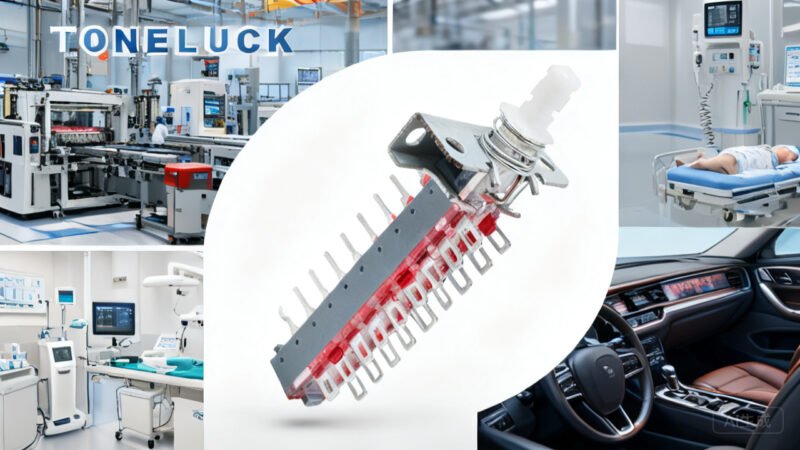
In the intricate world of industrial automation, consumer electronics, and specialized machinery, countless unseen components work tirelessly to ensure precision, safety, and seamless operation. Among these critical elements, the micro switch stands out as a fundamental yet often underestimated hero. For any micro switch manufacturer, understanding and delivering on the nuanced demands of various industries is paramount. This article delves into the profound importance of micro switches, their diverse applications, and the key considerations for businesses seeking optimal performance and longevity.
At its core, a micro switch is a small, snap-action electrical switch characterized by its highly sensitive actuation. Its defining feature is the snap-action mechanism, which ensures a rapid change in contact state regardless of the speed of actuation. This ‘snap’ provides a crisp, reliable electrical signal, making it ideal for applications requiring precise detection of position or presence.
Invented in 1932, the micro switch has evolved significantly, but its fundamental principle remains unchanged: to convert mechanical movement into an electrical signal with high repeatability and minimal hysteresis. Its compact size, robust construction, and high current rating capabilities for its size make it an invaluable component across a spectrum of industries.
Key Characteristics and Advantages
The widespread adoption of micro switches stems from several distinct advantages:
- Precision and Repeatability: The snap-action mechanism ensures a consistent actuation point, crucial for applications requiring exact positioning or timing.
- Durability and Longevity: Designed for millions of cycles, high-quality micro switches offer exceptional operational life, reducing maintenance and replacement costs.
- Compact Design: Their small footprint allows integration into tight spaces, a significant advantage in miniaturized devices and complex assemblies.
- Versatility: Available in a vast array of actuator styles (plunger, lever, roller, simulated roller) and terminal types, they can be customized for almost any mechanical interface.
- High Current Capacity: Despite their size, many micro switches can handle substantial electrical loads, making them suitable for direct control of motors and solenoids.
Types and Applications Across Industries
The versatility of the micro switch is best illustrated by its numerous variations and applications:
Limit Switches: The Industrial Guardian
A specialized form of micro switch, the limit switch is predominantly used in industrial settings to detect the presence or absence of an object, or to monitor whether the travel limits of moving machinery have been reached. They are robust, often housed in protective enclosures, and are fundamental to safety interlocks, conveyor systems, robotic arms, and automated assembly lines. Their ability to withstand harsh industrial environments makes them indispensable for preventing overtravel and ensuring operational safety.
Waterproof Micro Switches: Resilience in Harsh Environments
For applications exposed to moisture, dust, or corrosive agents, the waterproof micro switch is a game-changer. These switches feature sealed housings and internal mechanisms, often meeting IP (Ingress Protection) ratings like IP67, ensuring reliable operation even when submerged or subjected to high-pressure washdowns. Common applications include outdoor equipment, marine systems, industrial washdown facilities, automotive systems, and consumer appliances like washing machines and dishwashers.
Miniature and Subminiature Micro Switches
As devices become smaller, so too must their components. Miniature and subminiature micro switches, such as the MQS-9A Mini Micro Switch, offer the same reliable snap-action performance in an even more compact package. These are crucial for consumer electronics, medical devices, automotive door latches, and various handheld tools where space is at a premium.
Widespread Applications:
- Industrial Automation: Robotics, CNC machines, safety gates, material handling.
- Automotive: Door latches, seat belt detection, gear shift interlocks, power window controls.
- Home Appliances: Microwave ovens, washing machines, refrigerators, vacuum cleaners.
- Medical Devices: Hospital beds, diagnostic equipment, infusion pumps.
- HVAC Systems: Damper controls, fan interlocks.
- Security Systems: Door/window sensors, alarm triggers.
Choosing the Right Micro Switch: Critical Considerations
Selecting the appropriate micro switch is crucial for the performance and longevity of any system. Businesses should evaluate several factors:
- Electrical Ratings: Ensure the switch can handle the required voltage and current (AC/DC). Overloading can lead to premature failure.
- Operating Force: Match the switch’s actuation force to the application’s mechanical input.
- Actuator Type: Select an actuator (pin plunger, lever, roller lever) that interfaces correctly and reliably with the mechanical system.
- Environmental Conditions: For harsh environments, a waterproof micro switch or one with a higher IP rating is essential to resist dust, moisture, and temperature extremes.
- Life Expectancy: Consider the number of cycles the switch is expected to perform over its lifetime.
- Material and Construction: The housing and contact materials impact durability and resistance to specific chemicals or temperatures.
- Certifications: Look for industry-specific certifications (e.g., UL, CE, CQC) to ensure compliance and safety standards.
The Importance of a Reputable micro switch manufacturer
The reliability of your end product is only as strong as its weakest component. Partnering with an experienced and reputable micro switch manufacturer is non-negotiable. A leading manufacturer like TONELUCK micro switch, for instance, not only provides a wide range of standard and specialized products but also offers:
- Quality Assurance: Rigorous testing and adherence to international quality standards (ISO 9001) ensure consistent performance.
- R&D and Innovation: Continuous development of new designs, like advanced waterproof micro switch technologies or ultra-miniature models, to meet evolving industry needs.
- Customization Capabilities: The ability to tailor switches to unique application requirements, including specific actuator designs, terminal configurations, or electrical ratings.
- Technical Support: Expert guidance in selecting the optimal switch and troubleshooting potential issues.
Conclusion: Small Component, Monumental Impact
Micro switches, though small, play a monumental role in the functionality, safety, and efficiency of countless B2B applications. From the robust limit switch ensuring industrial safety to the resilient waterproof micro switch operating flawlessly in challenging conditions, their precision and durability are foundational. For businesses and engineers, understanding the nuances of these vital components and collaborating with a trusted micro switch manufacturer is key to building reliable, high-performing systems that stand the test of time. Investing in quality micro switches is an investment in the overall integrity and success of your products and operations.
